Snow Photoshoot in Austria: where, when and how to stay warm
Snow in Austria is not a season, it is an altitude. The valley floors of the famous winter towns are lower than most people assume — Kitzbühel sits at 762 metres, Zell am See and Schladming at around 750 — and in a mild January those streets can be wet grey tarmac while the mountain above them is buried. The reliable white starts higher: the Seefeld plateau at about 1,180 metres, the Planai at 1,906, the glaciers above 2,700, where there is snow in August. Plan a winter shoot around a town and you are gambling; plan it around a height and a lift and you are not.
When the snow is actually there
The main season runs from about mid-December to the end of March at resort altitude. February usually holds the deepest cover; late March gives longer days, softer light and snow that is still good above 1,500 metres.
What matters more than the month is the week. Fresh snow on trees separates a winter picture from a merely cold one, and it does not last: wind strips the branches within a day and strong sun does the rest. The prize is the morning after a fall, when high pressure moves in behind the front — blue sky, loaded pines, untouched ground. If your dates can move by a day, say so when you book: that is worth more than any choice of location.
If the snow is not there, go up. The Kitzsteinhorn above Kaprun carries snow at three thousand metres in August, the Dachstein glacier above Schladming is white in every month, and in the Zillertal the Hintertux glacier is the one place in Austria whose lifts run every day of the year — the insurance policy for a January that turns green.
Kitzbühel: painted houses under snow
Kitzbühel is the winter town that photographs best without a mountain in the frame at all. The Vorderstadt is a curving pedestrian street of deep gabled merchant houses in ochre, pink and green, closed at one end by the Jochberger gate arch and by two church towers at the other. Under snow with the street lights on, the colour does all the work, and overcast is genuinely good here because there are no shadows to fight.
One warning: for a week in the second half of January the Hahnenkamm races turn the town into a grandstand and the centre is unusable for a shoot. The date moves each year, so check it before booking in January.
Above the town, the Hahnenkamm gondola takes about eight minutes from the western edge of the centre to a ridge facing the grey wall of the Wilder Kaiser. Two kilometres out, the Schwarzsee freezes and is cleared for skating in most winters — most, not all: the ice is released only when the town says so.
Zell am See and Kaprun: a lake that sometimes freezes, a glacier that never melts
Zell am See gives the widest range of winter pictures within twenty minutes of one another. The Esplanade is the easy, level hour: jetties, the old town on its promontory and the Kitzsteinhorn closing the valley in snow across the water. Before nine the lake is usually glass; evening light lands on the far shore at Thumersbach, so shoot from that side if you want the town lit.
In a hard winter the lake freezes solid enough for skaters and a marked path across to Thumersbach — a photograph nothing else in the country gives. It is never a promise: check the state of the ice first, and never step onto a frozen lake that has not been officially released.
Above the town, the Schmittenhöhe is a ten-minute cable car to 1,965 metres, a small white chapel and a horizon of about thirty peaks over three thousand metres. It is a working ski area, so shoot early or well away from the pistes. At Kaprun the Kitzsteinhorn puts a viewing platform at around 3,029 metres with a gallery tunnelled through the rock; allow an hour each way, expect the lifts to stop for wind, and keep it short, because three thousand metres is felt.
Seefeld: the calmest snow in Tyrol
If a ski resort in full flow is not what you had in mind, Seefeld is the answer. The plateau sits at about 1,180 metres above the Inn valley, high enough to stay white long after Innsbruck has changed, and the signature frame needs no lift at all: the Seekirchl, a white chapel with an onion dome alone on an open meadow, nothing behind it but snow and the Karwendel.
In winter the cross-country tracks are groomed right past it. Stay off the classic tracks — they are in constant use — and work from the trodden edge. Five minutes away the Wildsee freezes and is cleared for skating, reeds standing out of the ice, and the level path around it is walkable in ordinary boots. For height without effort, the Rosshütte funicular climbs to about 1,750 metres in under ten minutes; walk five minutes from the top station, which is where the buildings drop out of the frame.
What clients say about this kind of shoot
We are overjoyed with the photos from our wedding. Ian and Kiran not only have a fantastic eye for the special moments, they also bring a wonderfully relaxed and caring manner. Our guests were thrilled too! Thank you so much for the priceless memories and for your amazing dedication. We couldn't have wished for a better photographer ♥️
— Behiye O. on Ian P.
We're so happy we chose you! From the very first contact, everything was totally hassle-free and pleasant. Both at the pre-wedding shoot and on the wedding day we felt really comfortable with you, and everything was really relaxed and professional. The photos turned out really great and we're absolutely thrilled with the result! You captured the most beautiful moments of our day perfectly and gave us truly lovely memories. Thank you so much for your amazing work! We'd book you again any time and can't recommend you enough! ❤️
— Chelsea B. on Ian P.
Very professional, likeable and easy to work with. The photos turned out beautifully and capture our wedding day in a very special way. We're very happy and can definitely recommend him!
— Tony P. on Ian P.
Super friendly, creative, dedicated photographers! We clicked right away, they were really accommodating and delivered on time! Absolutely amazing photos that we always love looking at 😍
— Rechusmile on Ian P.
For our wedding, nothing mattered more to us than capturing the special moments and emotions forever. So naturally we had pretty high expectations of our photographers and videographers – and finding them was probably one of the biggest strokes of luck in our wedding. ❤️ On the day itself, we already felt incredibly comfortable with the two of them. They're super friendly, warm-hearted and at the same time absolutely professional. You can tell right away that they know 100% what they're doing, and they still manage to capture the moments completely naturally, without anything feeling posed. At first we even thought we didn't really need a video and were only looking for a photography team. Today we can say: we needed this video!!!🥹 The video truly exceeded our expectations. Watching it feels like living our wedding day all over again – with all the emotions, the voices and the little moments that we ourselves didn't even consciously take in on the day. And the photos turned out simply beautiful too, capturing our day exactly the way we want to remember it. We are incredibly grateful that the two of them were by our side at our wedding and captured these special memories for us. We would choose them again any time and recommend them with all our hearts. ❤️
— Marlene on Ian P.
For our wedding this year, we were looking for someone to capture our special day exactly as we were – authentic, personal, and with all the little moments that made it so special. Since I consider myself a photographer, I had correspondingly high expectations for our wedding photos. Dani not only met them, but absolutely exceeded them. Thank you, Dani, for the incredibly smooth day, the wonderful preliminary discussions, and above all, for being so warm and genuinely interested in us from the very beginning. For everyone reading this: our highest recommendation! Book her, no matter the price; it's definitely worth it – it's the combination of genuine interest in people and photos with an eye for detail. This very mix is what makes her pictures so unique for us. Thank you for capturing our day exactly as we experienced it. We couldn't have wished for anyone better.
— Stefan W. on Dani H.
Schladming: two altitudes in one day
Schladming is the pick when you want the contrast between a town and something genuinely high. The Planai gondola leaves from the middle of town and puts you at 1,906 metres in ten minutes, the limestone wall of the Dachstein filling the northern sky. In winter it is the middle of a working ski area, so expect groomed, busy ground, walk five minutes off the top station, and check the hours: for much of the year the lift stops well before sunset.
The other half of the destination is the Dachstein-Südwandbahn from Ramsau, which climbs in one span to about 2,700 metres. Everything worth photographing is minutes from the top station: the Skywalk balcony out over a 250-metre drop, Austria's highest suspension bridge, and the glass steps hanging off the end of it. It is routinely fifteen degrees colder than the valley and much windier; platform and bridge close in storms, bridge and ice palace are ticketed separately from the ride, and the cable car takes a maintenance break between seasons. Check conditions and the last descent before going up.
Down in town, the old square of painted houses and arcades fills at the end of the ski day and carries an Advent market in December. Shoot the arcades from inside — the columns frame a couple and keep the light even.
Staying warm enough to look relaxed
This is the part that decides whether the photographs work. Cold shows: shoulders climb, hands disappear into sleeves, faces tighten, nobody looks at anybody. The fix is boring and completely effective. Wear thermals under everything, including under a dress, and treat the coat as the outfit rather than the thing you take off for the good frames. Walk in proper boots and carry the shoes you want in the pictures. Put a hand warmer in each coat pocket, choose a hat and gloves you can get on and off in two seconds, bring dry socks, and avoid denim, which soaks and then freezes.
Sixty minutes is a long time at minus ten, and it is usually enough. Plan a hut or a gondola station roughly in the middle, and shoot the frames that matter most first, while everybody still looks comfortable.
What snow does to a photograph
Snow reflects most of the light that hits it, which fools a camera into rendering it grey, so a photographer will deliberately overexpose. That is their problem, not yours, but it explains why snow looks better in low sun than at midday, when a snowfield becomes a white blank with no texture. Overcast is not a disaster here: flat light is soft, even and kind to faces.
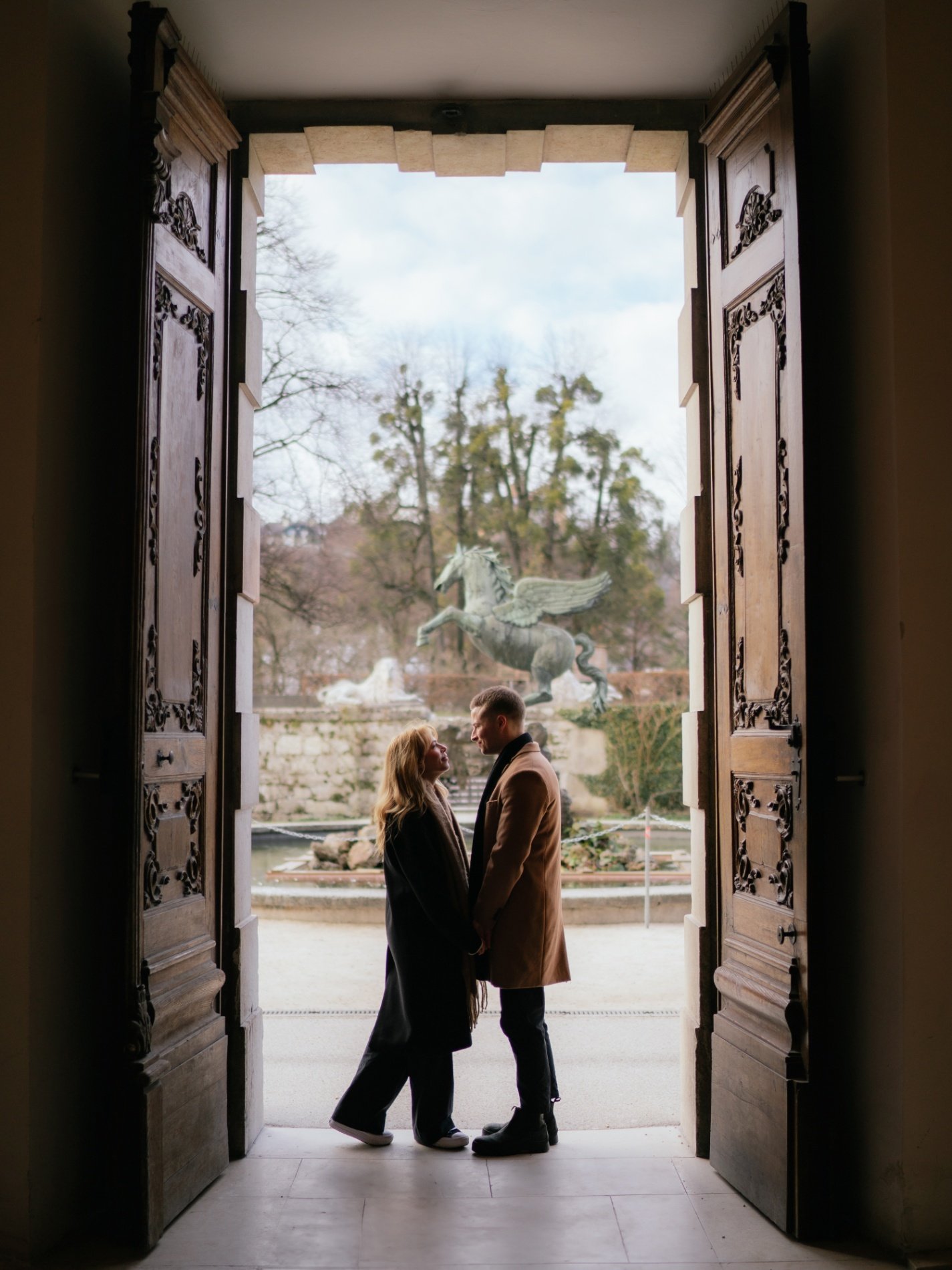
What you can control is contrast. Dark, plain coats separate cleanly from white ground; white and pale grey vanish into it. Deep colours — burgundy, forest green, navy, camel — read strongly against snow and pine, and a scarf or a blanket gives skin tones something warm to sit against.
Planning a snow photoshoot in Austria
Winter days are short: in mid-January the Tyrolean sun rises around 07:50 and sets around 16:45, and the whole usable day behaves like one long golden hour. That is the good news — there is no harsh midday light to avoid, and a session at ten in the morning works, which is not true in July.
Sixty minutes suits the cold and covers one place properly: a village street, a lakeshore, a chapel on its meadow. A hundred and twenty makes sense when a lift is involved, because the ride up and down eats a third of it. Book early for the holiday weeks around Christmas, New Year and in February, when the resorts are full and so are the diaries.
A local photographer knows which slope has been cleared, which lift is running this week and where the sun still reaches at three in the afternoon. You can browse photographers across Austria and book online, with couples sessions from €429 all-inclusive.
Want professional photos in Schladming?
Browse portfolios, compare packages, and book a verified local photographer in minutes.