What to Wear for a Mountain Photoshoot in Austria
Two things ruin more Austrian mountain photographs than bad weather: clothes that disappear into the background, and shoes that stop you reaching the place worth standing in. Everything else — the light, the peak, the reflection in the lake — the photographer can work with. Nobody can rescue a bright green jacket against a June meadow or a pair of smooth-soled dress shoes on a gravel path with drops beside it.
The good news is that Austrian mountain locations are unusually forgiving about access. Plenty of the best frames in the country are a few minutes from a cable-car station or a car park. The clothing question is therefore less about survival gear and more about two things: the temperature you will actually be standing in, and how your colours behave against grass, limestone or snow.
Work out the temperature at the top, not in the village
Air cools by roughly six degrees for every thousand metres you climb, so a cable car that lifts you a thousand metres puts you in air about six degrees colder before the wind is counted — and on an open ridge or a platform the wind always counts. The numbers on real Austrian locations are blunter than the physics. The Rofan cable car above the Achensee reaches the Erfurter Hütte at 1,834 metres, where it is often ten to fifteen degrees colder and much windier than the lakeshore you left. The Rosshütte funicular above Seefeld runs regularly ten degrees colder than the village. The Dachstein station above Schladming, at about 2,700 metres, is routinely fifteen degrees colder than the town below, and the Kitzbüheler Horn above Kitzbühel about ten.
That is the number to dress for. A summer evening at 20°C in the valley is 5–10°C on the ridge, standing still, in wind, with your hands out of your pockets for forty minutes. Plan the outfit for the coldest point of the session and let the photographer shoot the layers coming off, not going on. And check the lift's operating dates before you plan around it — most Austrian cable cars pause between the summer and winter seasons.
Colour: what actually holds against an Austrian background
Three backgrounds, three answers.
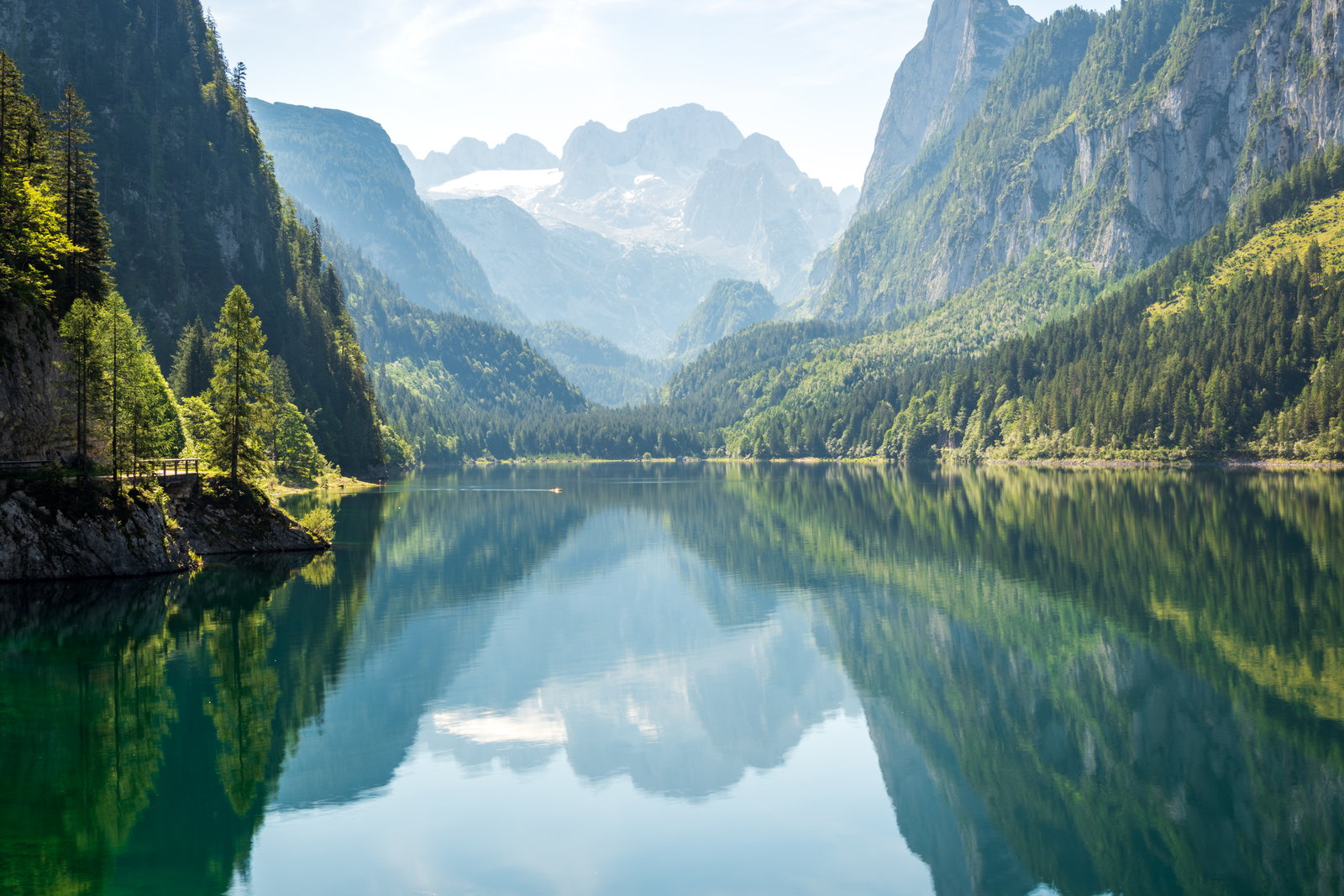
Green meadow, June to September. Grass is a mid-tone that eats anything close to it. Bright green, olive and khaki disappear; so does anything neon, which also throws colour onto skin. What holds up is warm and slightly desaturated — cream, oatmeal, camel, rust, terracotta, dusty rose, deep burgundy — or a clean dark like navy and charcoal, which reads as a shape against the grass. At Gosau the same rule applies to the lake shore: the water is green, the forest is green, and a cream dress is the only thing in the frame that is not.
Grey limestone. The Gosaukamm, the Karwendel above the Achensee, the Wetterstein across the Seefeld plateau — all of it is pale grey rock with hard edges. It is the easiest background there is, because almost any warm colour separates from it. Rust, mustard, brick, deep green and burgundy all sit well.
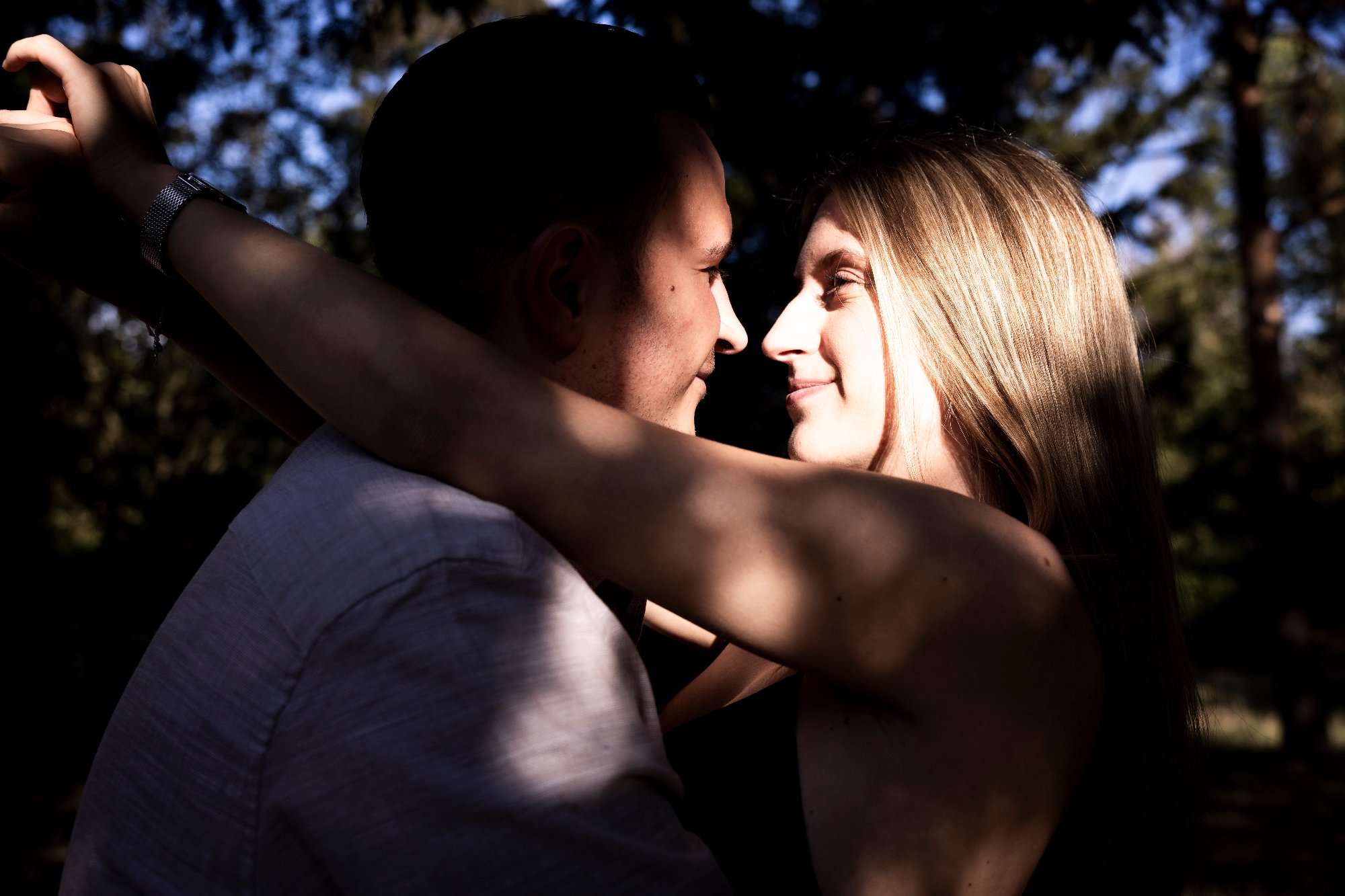
Snow. Snow is the trap, because it is brighter than everything and it fools people into wearing white. White on white is a silhouette with no detail; the camera will expose for the snow and your coat will vanish. Winter wants saturated mid- and dark tones: camel, forest green, burgundy, navy, charcoal, deep red. A single strong colour between two people beats two competing ones.
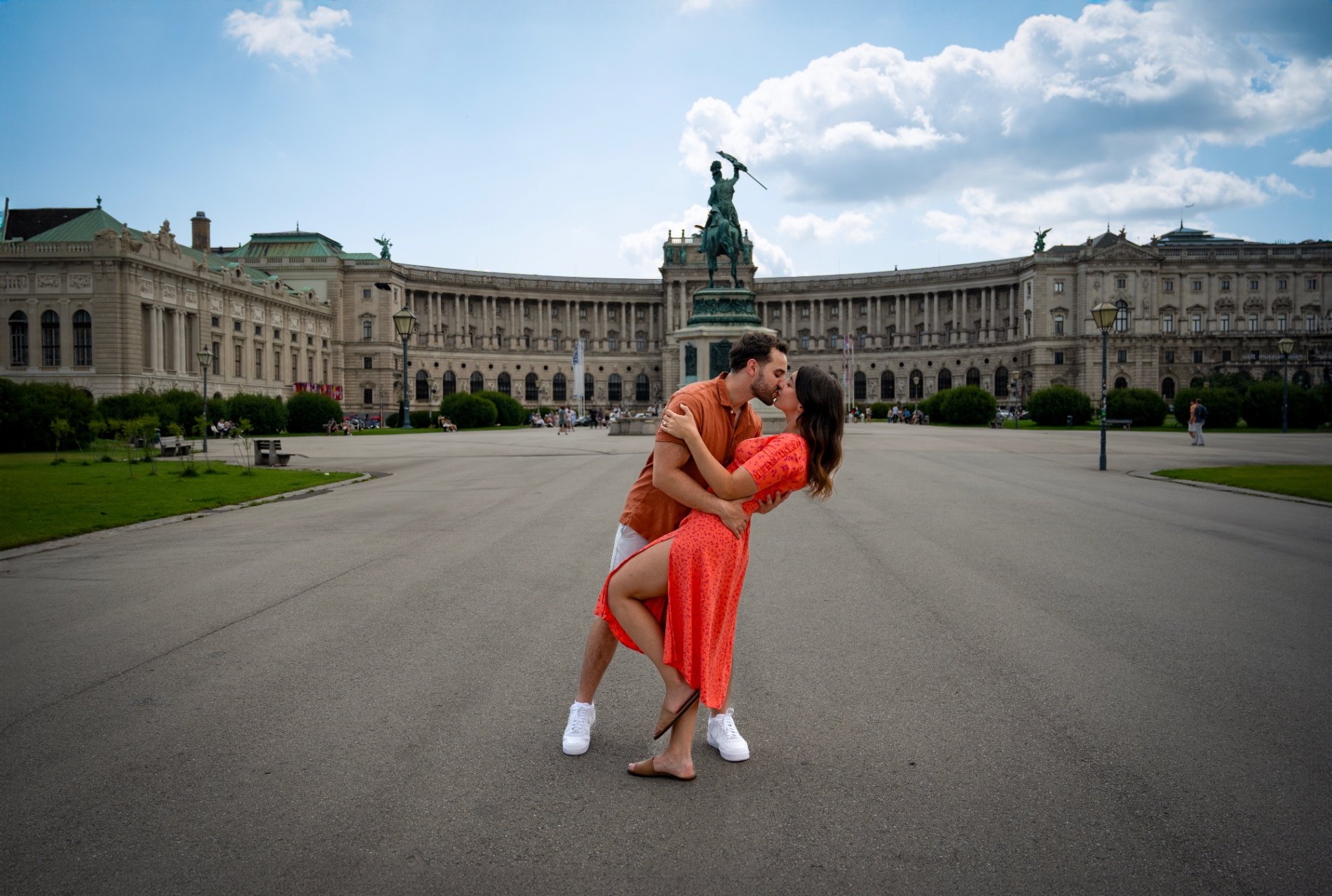
Whatever the season, avoid large logos, busy prints and anything with hard black-and-white stripes, which flicker in a photograph. Coordinate, do not match — two people in identical outfits look like a uniform, two people in the same three-colour family look intentional.
Layers that come off cleanly
The layering rule for a photoshoot is different from the layering rule for a hike. You want the layer you take off to be as photogenic as the one underneath, because you will be in both. A wool coat over a knit, a long cardigan over a dress, a blanket wrap that reads as styling rather than as emergency equipment. What does not work: crinkly technical shells that rustle, hoods that swallow faces, and puffer jackets so thick that nobody has a waist.
Bring gloves and take them off for the ten seconds each frame needs, a hat you like being photographed in rather than the warmest one, and one more layer than you think — you can leave it in the bag, and at the top station you cannot buy it.
Shoes: the part people get wrong
Almost every good Austrian mountain location involves some walking on loose ground. The circuit of the Vorderer Gosausee is flat but gravel, and takes about an hour. The shore path to the Gaisalm on the Achensee is ninety minutes of narrow, rocky trail carved above the water, partly exposed — genuinely not a place for long dresses or smooth soles. Even the short walk from a top station to where the buildings drop out of frame is usually rock, grass and mud.
The answer is not to compromise on the footwear you wear in the pictures; it is to carry it. Walk in boots or trainers, change at the spot, shoot, change back. Most sessions here are one location, so this costs you two minutes. In winter add the thing everyone forgets: something to stand on. Ten minutes still on packed snow in thin-soled shoes ends a session early.
What clients say about this kind of shoot
We are overjoyed with the photos from our wedding. Ian and Kiran not only have a fantastic eye for the special moments, they also bring a wonderfully relaxed and caring manner. Our guests were thrilled too! Thank you so much for the priceless memories and for your amazing dedication. We couldn't have wished for a better photographer ♥️
— Behiye O. on Ian P.
We're so happy we chose you! From the very first contact, everything was totally hassle-free and pleasant. Both at the pre-wedding shoot and on the wedding day we felt really comfortable with you, and everything was really relaxed and professional. The photos turned out really great and we're absolutely thrilled with the result! You captured the most beautiful moments of our day perfectly and gave us truly lovely memories. Thank you so much for your amazing work! We'd book you again any time and can't recommend you enough! ❤️
— Chelsea B. on Ian P.
Very professional, likeable and easy to work with. The photos turned out beautifully and capture our wedding day in a very special way. We're very happy and can definitely recommend him!
— Tony P. on Ian P.
Super friendly, creative, dedicated photographers! We clicked right away, they were really accommodating and delivered on time! Absolutely amazing photos that we always love looking at 😍
— Rechusmile on Ian P.
For our wedding, nothing mattered more to us than capturing the special moments and emotions forever. So naturally we had pretty high expectations of our photographers and videographers – and finding them was probably one of the biggest strokes of luck in our wedding. ❤️ On the day itself, we already felt incredibly comfortable with the two of them. They're super friendly, warm-hearted and at the same time absolutely professional. You can tell right away that they know 100% what they're doing, and they still manage to capture the moments completely naturally, without anything feeling posed. At first we even thought we didn't really need a video and were only looking for a photography team. Today we can say: we needed this video!!!🥹 The video truly exceeded our expectations. Watching it feels like living our wedding day all over again – with all the emotions, the voices and the little moments that we ourselves didn't even consciously take in on the day. And the photos turned out simply beautiful too, capturing our day exactly the way we want to remember it. We are incredibly grateful that the two of them were by our side at our wedding and captured these special memories for us. We would choose them again any time and recommend them with all our hearts. ❤️
— Marlene on Ian P.
For our wedding this year, we were looking for someone to capture our special day exactly as we were – authentic, personal, and with all the little moments that made it so special. Since I consider myself a photographer, I had correspondingly high expectations for our wedding photos. Dani not only met them, but absolutely exceeded them. Thank you, Dani, for the incredibly smooth day, the wonderful preliminary discussions, and above all, for being so warm and genuinely interested in us from the very beginning. For everyone reading this: our highest recommendation! Book her, no matter the price; it's definitely worth it – it's the combination of genuine interest in people and photos with an eye for detail. This very mix is what makes her pictures so unique for us. Thank you for capturing our day exactly as we experienced it. We couldn't have wished for anyone better.
— Stefan W. on Dani H.
Dresses and veils in wind
Wind is the constant on any Austrian ridge, saddle or platform, and it is far stronger at a cable-car station than in the valley you looked at the forecast for. This is not a reason to leave the dress at home — wind is the best thing that can happen to a long dress, and a veil at a viewpoint is the single most dramatic frame the Alps offer. It is a reason to plan where each garment gets used.
A structured dress with weight in the hem behaves on an exposed ridge. Loose chiffon, a wide-brimmed hat and an unpinned veil do not — they behave beautifully for about four frames and then wrap around your face. Pin the veil properly, bring hair ties, and think of the sequence in two halves: the flowing, unpinned version on the sheltered lake shore or in the meadow, and the structured version up top. The meadow around the Seekirchl chapel at Seefeld is a good example of the sheltered half, and it is a five-minute walk from the village.
Tracht: yes, but do it properly
Dirndl and Lederhosen are not a costume in Austria; they are clothes people actually own and wear to weddings, to church and to village festivals. That is precisely why hired Oktoberfest outfits read badly in a photograph — the cheap synthetic ones look like what they are. If you want Tracht in your pictures, buy or borrow something decent, in a plain wool or linen rather than a printed novelty fabric, and wear it as it is worn: the dirndl with a proper blouse and apron, the Lederhosen with real shoes and socks rather than trainers.
One detail worth knowing. Where the apron bow is tied is read as a statement: on the wearer's left means unattached, on the right means married, engaged or otherwise spoken for, at the front centre traditionally means a virgin or someone undecided, and at the back is for widows — and for waitresses, who tie it there so it stays out of the way. The code is more recent than the clothing, but people still read it, so tie it on purpose. For an engagement or anniversary session, right side.
Children
Dress children for playing rather than standing still, because the keepers are the frames where they move. Layers they can manage themselves, a full spare set in the bag, mittens attached to the coat. Boots beat anything smart; a session at a lake or in snow always ends with wet feet. Keep the colours simple across the family — one warm palette across four people reads as a group, four separate ideas read as four people who arrived together.
Planning a mountain photoshoot in Austria
Sixty minutes is enough for one mountain location: a lake shore, a meadow and chapel, or a top station and the ground just beyond it. Two hours lets you ride a lift and use both the summit and the valley, which is also the honest answer to the clothing question — one outfit for each. Book the earliest or the latest slot of the day: high alpine light is flat in the middle and the afternoon cloud that builds over glaciers in summer is the rule rather than the exception.
Tell the photographer what you plan to wear before the day. They know whether the path to the frame is gravel or rock, how much wind that saddle gets and whether the lift is running. A couples session starts at €429 all-inclusive for sixty minutes, €509 for two hours and €749 for three; the same applies to a family session or a mountain elopement. You can browse photographers across Austria and book online.
Want professional photos in Seefeld?
Browse portfolios, compare packages, and book a verified local photographer in minutes.