Kitzbühel Photoshoot Guide: the painted town, the Hahnenkamm and Schwarzsee
Kitzbühel is a fifteen-minute walk end to end and it holds together as a backdrop better than almost any resort in the Alps, because it was a rich town four hundred years before it was a ski town. Silver and copper came out of the Kitzbüheler Horn from the 1400s, and the merchants spent it on the Vorderstadt: tall gabled houses in apricot, green, ochre and dusty pink, arched passages through to the courtyards, oriel windows at first-floor height. Above the town on one side is the Hahnenkamm and the most feared downhill course in ski racing; on the other, a 1,996-metre summit with a free alpine flower garden on its flank. Two kilometres out there is a dark moor lake that mirrors. That is a full day of frames within a very small radius — and one week in January when none of it is available.
The Vorderstadt: shoot uphill from the bend
The street bends, and that is the whole trick. From the lower end, near the Hinterstadt junction, the painted façades stack into each other and the towers of the Liebfrauenkirche and the parish church of St. Andreas close off the view. Shoot uphill from there and you get compression, colour and a real street rather than a set.
Light in the Vorderstadt is a question of when the sun clears the roofs — roughly nine to ten in summer, considerably later in winter. The last hour of daylight paints the east side of the street. Overcast is genuinely good here, which is not true of most alpine locations: the plaster colours carry the picture and there are no hard shadows to fight.
The passages and courtyards
Off the street, arched passages lead through to courtyards with arcades and warm plaster. They hold cool, even light at any hour, which makes them the answer to midday, when the street itself goes contrasty and hopeless. Look for them between the Vorderstadt and the Hinterstadt; several are through-routes and open, but they belong to the houses, so keep a session in them short and quiet.
The street is pedestrianised, so there is no traffic to work around. What there is instead is delivery vans in the early morning and shop life from about ten — neither is fatal, but both put the good hour at nine.
The Hahnenkamm: eight minutes to 1,665 metres
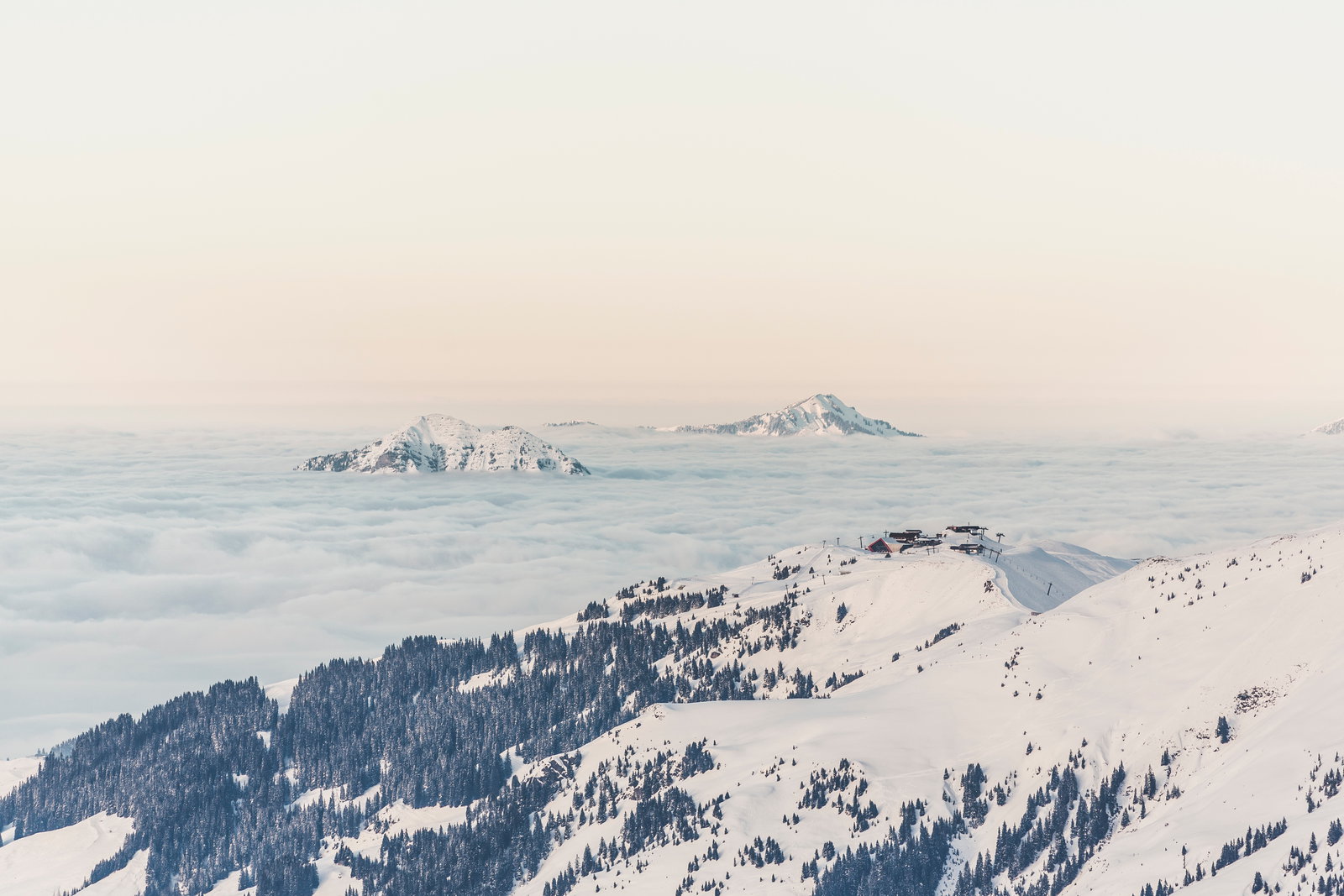
The Hahnenkammbahn leaves from the western edge of town and the ride takes about eight minutes, which makes this the easiest big mountain view in Tyrol: no walk, no drive, town to ridge in the time it takes to change a lens. The top station sits just below the summit and the ground opens north across the valley to the long grey wall of the Wilder Kaiser.
Two frames matter up here. The ridge itself, with the Kitzbüheler Alps rolling away in green or white folds and the Kaiser as the hard line behind, is the wide shot; place people small in it. The other is the start of the Streif a few minutes along the ridge.
The Streif start
The Streif begins on the Hahnenkamm at 1,665 metres and drops 860 metres over 3,312 metres of course to the edge of town. Its steepest section, the Mausefalle, runs at close to 86 per cent. Standing at the gate and looking down is the picture — you do not need to explain it to anyone. The start house was rebuilt in concrete, wood and glass for the town's 750th anniversary in 2021, and in summer the mountain carries a set of activity stations along the real key sections of the course.
Light is easiest early, when the Wilder Kaiser is clean and the haze has not built, and again in the last hour when the whole northern wall goes pink. Midday is flat in summer and glaring in winter. The gondola closes for the changeover between seasons — commonly part of April, May and November — so check what is running before you build a session around the ride.
The Kitzbüheler Horn and the alpine flower garden
The Horn is the higher of the two mountains, at 1,996 metres, and it is the summer choice. A toll road climbs about seven and a half kilometres to the Alpenhaus at roughly 1,670 metres; the Hornbahn gondola does the same job from town. Both are seasonal — the road runs roughly from May to early November and the gondola for a shorter window inside that — so check the current dates and the toll before driving up.
The Alpenblumengarten is spread over the slope just below the top: an open, free hillside of several hundred alpine species in beds and rock terraces, with gravel paths between them. In late June and July it is a wall of colour with the valley falling away behind it. From the summit terrace the view runs south over the Kitzbüheler Alps to the ice of the Hohe Tauern, with the Grossglockner and the Grossvenediger on the skyline in clear air — cleanest in the morning, hazier by afternoon.
Take a warm layer. At just under two thousand metres it is regularly ten degrees colder than the Vorderstadt, and the summit is exposed.
What clients say about this kind of shoot
We are overjoyed with the photos from our wedding. Ian and Kiran not only have a fantastic eye for the special moments, they also bring a wonderfully relaxed and caring manner. Our guests were thrilled too! Thank you so much for the priceless memories and for your amazing dedication. We couldn't have wished for a better photographer ♥️
— Behiye O. on Ian P.
We're so happy we chose you! From the very first contact, everything was totally hassle-free and pleasant. Both at the pre-wedding shoot and on the wedding day we felt really comfortable with you, and everything was really relaxed and professional. The photos turned out really great and we're absolutely thrilled with the result! You captured the most beautiful moments of our day perfectly and gave us truly lovely memories. Thank you so much for your amazing work! We'd book you again any time and can't recommend you enough! ❤️
— Chelsea B. on Ian P.
Very professional, likeable and easy to work with. The photos turned out beautifully and capture our wedding day in a very special way. We're very happy and can definitely recommend him!
— Tony P. on Ian P.
Super friendly, creative, dedicated photographers! We clicked right away, they were really accommodating and delivered on time! Absolutely amazing photos that we always love looking at 😍
— Rechusmile on Ian P.
For our wedding, nothing mattered more to us than capturing the special moments and emotions forever. So naturally we had pretty high expectations of our photographers and videographers – and finding them was probably one of the biggest strokes of luck in our wedding. ❤️ On the day itself, we already felt incredibly comfortable with the two of them. They're super friendly, warm-hearted and at the same time absolutely professional. You can tell right away that they know 100% what they're doing, and they still manage to capture the moments completely naturally, without anything feeling posed. At first we even thought we didn't really need a video and were only looking for a photography team. Today we can say: we needed this video!!!🥹 The video truly exceeded our expectations. Watching it feels like living our wedding day all over again – with all the emotions, the voices and the little moments that we ourselves didn't even consciously take in on the day. And the photos turned out simply beautiful too, capturing our day exactly the way we want to remember it. We are incredibly grateful that the two of them were by our side at our wedding and captured these special memories for us. We would choose them again any time and recommend them with all our hearts. ❤️
— Marlene on Ian P.
For our wedding this year, we were looking for someone to capture our special day exactly as we were – authentic, personal, and with all the little moments that made it so special. Since I consider myself a photographer, I had correspondingly high expectations for our wedding photos. Dani not only met them, but absolutely exceeded them. Thank you, Dani, for the incredibly smooth day, the wonderful preliminary discussions, and above all, for being so warm and genuinely interested in us from the very beginning. For everyone reading this: our highest recommendation! Book her, no matter the price; it's definitely worth it – it's the combination of genuine interest in people and photos with an eye for detail. This very mix is what makes her pictures so unique for us. Thank you for capturing our day exactly as we experienced it. We couldn't have wished for anyone better.
— Stefan W. on Dani H.
The Schwarzsee at sunset
The Schwarzsee is a peat lake two kilometres from the centre, and the peat is what gives it everything. The water is stained brown, which means it holds heat — by July it is often the warmest natural bathing water in Tyrol — and it means the surface goes almost black under a low sun, so a reflection reads as a clean mirror rather than as sky.
Work from the south-western shore, looking north-east across the reeds and the wooden jetties to the Kitzbüheler Horn. The lake is small enough that the mountain fills the back of the frame without a long lens. A path runs right round in about half an hour and the north-eastern end is the quiet one; the lidos and the boat rental are on the town side.
Sunset is the moment: the sun drops behind the western ridge, the Horn keeps light for another ten minutes and the water turns copper. The alternative is a cold September or October dawn, when moor lakes fog readily and the reeds come out of the mist. In winter the lake freezes and is cleared for skating in most years — never guaranteed, and only once the ice is released, which is worth checking locally rather than assuming.
Race week, Advent and the rest of the winter
One week in January the centre of Kitzbühel is a grandstand. The Hahnenkamm races fill the whole valley — the 2027 edition runs from 18 to 24 January, with the downhill on the Saturday — the Streif is fenced and off limits, and the town is not a photo location in any useful sense. The date moves every year, so check it before booking anything in January.
Advent is the opposite. The market in the historic centre runs from mid-November to shortly after Christmas — in 2026 from 18 November to 27 December, but confirm the current dates — and the painted street under snow and lights is the strongest winter frame in town. February and March give you deep snow, long light and no race circus.
Getting there and getting around
Kitzbühel is on the Salzburg–Tyrol railway, so it is reachable by direct train from both Salzburg and Innsbruck. Local trains also call at two halts in the town, Kitzbühel Schwarzsee and Kitzbühel Hahnenkamm — the latter is a few steps from the base station of the Hahnenkammbahn, and the former puts you at the lake without a car.
Once you are here, nothing needs driving. The Vorderstadt, the gondola base and the Schwarzsee are all within a half-hour walk of each other; the Horn is the only location that needs the road or the lift. If you want a contrast in the same trip, the Arlberg — St. Anton, Lech and Zürs — is the snow-certain, higher-altitude version of the same winter, about two and a half hours west.
Planning a Kitzbühel photoshoot
The efficient plan is two locations, not four. A morning session takes the Vorderstadt at nine and the courtyards when the light goes hard; an evening session takes the Hahnenkamm ridge and then the Schwarzsee for the last half hour. Sixty minutes is enough for the town alone; two hours lets you add either the lake or the ridge without rushing the gondola.
For a couples shoot the town is the reliable half and the mountain is the ambitious one, because the mountain depends on the lift running and on the cloud base. If the ridge is in cloud on the day, the painted street still works — that is the argument for starting in the Vorderstadt.
Sessions run 60, 120 or 180 minutes at €429, €509 and €749 all-inclusive. Someone who shoots Kitzbühel through the season will know which courtyard is open and whether the gondola is turning; you can browse photographers and book online.
Want professional photos in Kitzbühel?
Browse portfolios, compare packages, and book a verified local photographer in minutes.