Proposing in the Austrian Alps: Grossglockner, Achensee, Gosausee
There are two kinds of alpine proposal in Austria: the one at the end of a road or a lift, and the one at the edge of water with a mountain wall behind it. Neither asks you to climb anything. What ruins them is never the view, it is the calendar — Austria's highest road is shut for half the year, cable cars stop between the summer and winter seasons, and a top station closes for the day if it is blowing. Get those three right and the rest is easy.
The Grossglockner road: the biggest frame, the shortest season
The Großglockner-Hochalpenstraße runs from Bruck in Salzburg over the Hochtor pass to Heiligenblut in Carinthia: 48 kilometres, 36 hairpins and a high point above 2,500 metres, built in the 1930s purely so that people could look at the mountains. It is tolled and seasonal — open from about the start of May until the first heavy snow, usually late October or early November, with daily gate hours on top. All of it shifts year to year, so check before you plan around it.
The Kaiser-Franz-Josefs-Höhe at 2,369 metres is where the Carinthian spur ends, looking straight up the Pasterze — Austria's longest glacier — to the Grossglockner itself at 3,798 metres. The terrace is level and the whole picture is within fifty metres of the car park — a high-alpine proposal that needs no walking. Go in the first two hours after the gates open: clear air, side light across the ice, room to stand. By eleven on an August day the car park is full and cloud is building on the summit.
Halfway along, the Fuscher Törl is a saddle at 2,428 metres with a small stone chapel above the car park, a memorial to the workers who died building the road — the strongest single object on the pass and its coldest, windiest stop. The spur from here climbs two cobbled hairpins to the Edelweißspitze at 2,571 metres: a stone tower, a true 360-degree view, little shelter and less room, and it closes earlier than the main road.
At the Carinthian end, Heiligenblut's Gothic pilgrimage church stands on a rise with the Grossglockner directly behind its spire; the alignment holds only from a narrow arc, so walk the meadow north of the village until it lines up. It is the one frame here that survives winter, when the village stays reachable from the Carinthian side and the pass above is shut. More on the Grossglockner High Alpine Road.
Achensee: the proposal that does not depend on a road
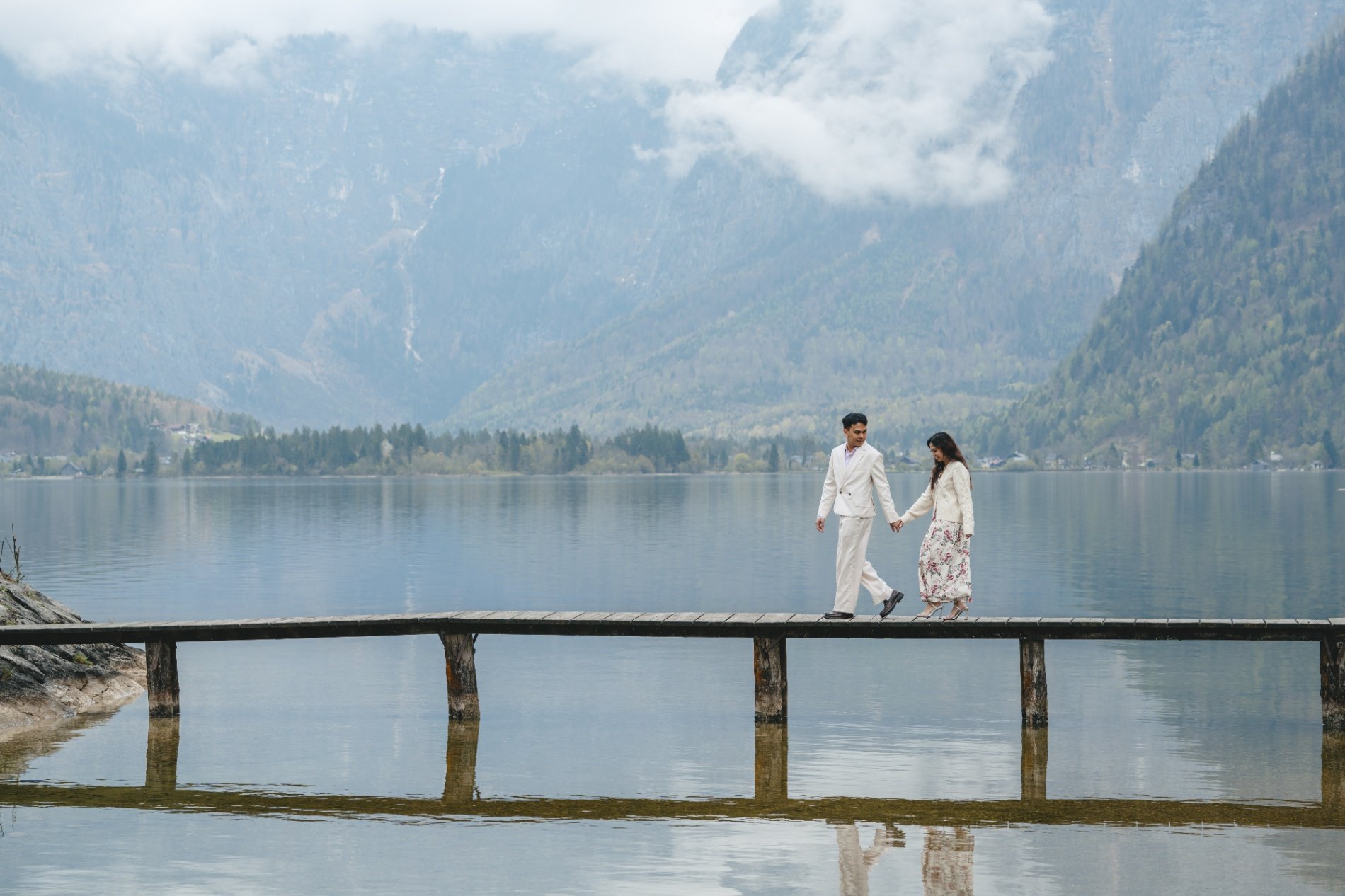
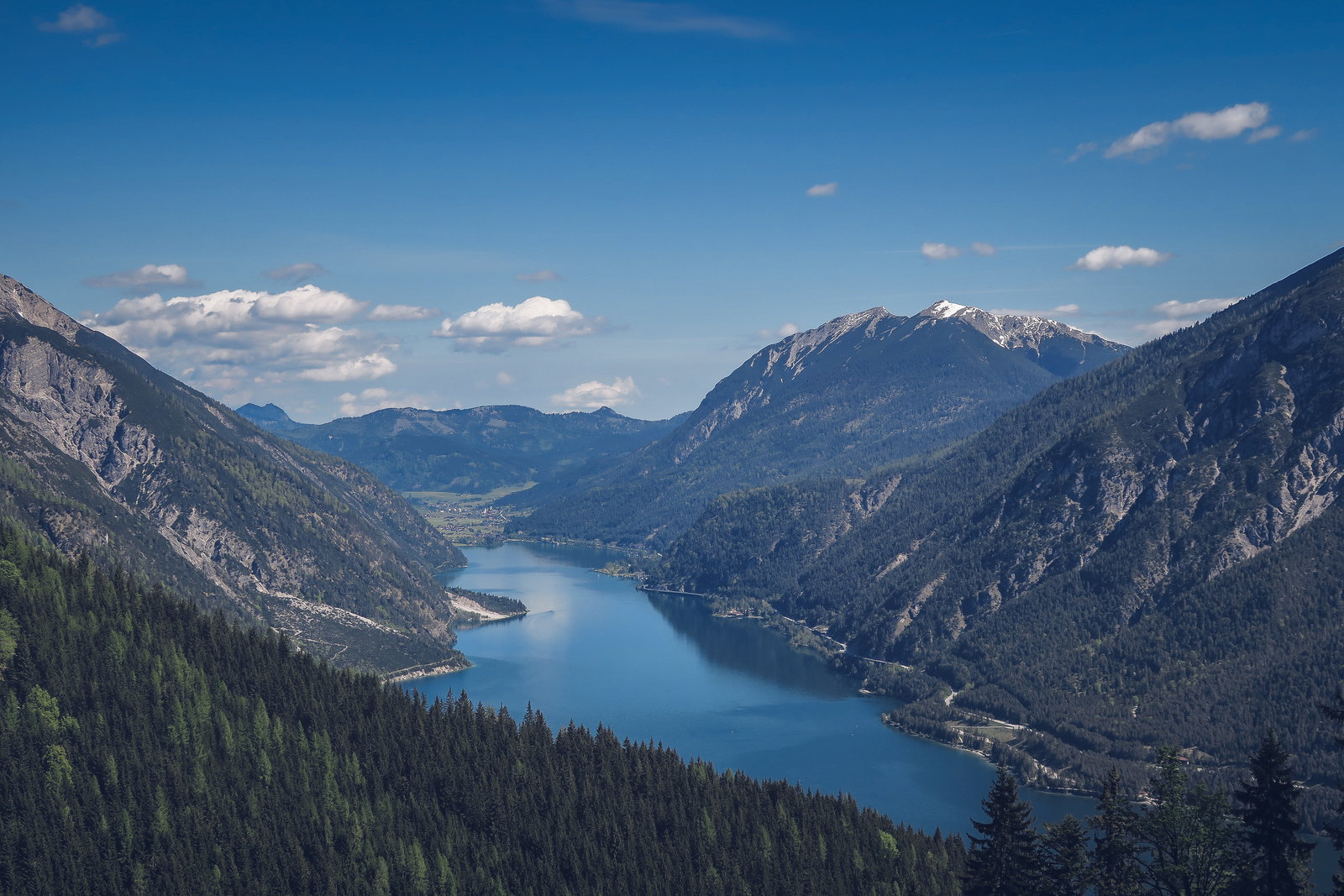
The Achensee lies at 929 metres in a trench between the Karwendel and the Rofan, nine kilometres long and rarely a kilometre wide, which is why the first sight of it from above Maurach reads more like a fjord than a lake. Pertisau on the western bay is the one flat shore: a level promenade about a kilometre long, wooden jetties, and the Karwendel going straight up out of the water opposite with nothing built on it.
The bay faces east, so morning light crosses the water and lights the far wall while the promenade is still soft; by late afternoon the mountain behind the village throws the shore into shadow. The wind gets up around midday and takes the reflections until evening. Walk out on a jetty rather than working from the promenade, where the moored boats crowd the foreground.
For the wide version, the Rofan cable car climbs from Maurach to the Erfurter Hütte at 1,834 metres in about eight minutes, and a few minutes past the hut an open shoulder puts all nine kilometres of lake below you, with no hiking. It runs ten to fifteen degrees colder and much windier than the shore, the lift pauses between seasons and the hours change every year, so check the operating dates. One extra for anyone willing to work for it: the Gaisalm, the only alpine hut in Tyrol reached by boat, under the cliffs of the roadless western shore — check the last sailing, and do not walk the ninety-minute shore path in a long dress. See the Achensee.
Gosausee: a mirror thirty seconds from the car
The Vorderer Gosausee lies at 933 metres about eight kilometres up the valley from Gosau village, and on a calm morning the Dachstein, its glacier and the grey teeth of the Gosaukamm all stand a second time in the water. The car park is at the northern end and the frame is a minute away — one of very few great alpine views in Austria that needs no walk at all. A flat path circles the lake in about an hour.
Two things decide whether you get the mirror. The first is the hour: the valley wind picks up late in the morning and breaks the surface, and the lake sits in shade until the sun clears the Gosaukamm, so the light arrives late, low and warm. The second is the water level — dammed since 1913, the lake works as a storage reservoir, drawn down over the winter and refilled by snowmelt in spring, usually at its highest around the middle or end of June, so late autumn shows a wider band of bare shore than the photographs suggest.
Parking is paid and the car park fills by mid-morning in July and August. June brings alpine roses, October turns the larches gold and takes the crowds away, and from December the lake lies under snow with the ridge black above it — the road is ploughed, but check conditions and whether the upper car park is open. More on Gosau and the Gosausee.
Zell am See and Kaprun: shore at eight, two thousand metres by nine
Zell am See is the practical choice when you want two different frames in one morning. The Esplanade runs north from the Elisabethpark past jetties and rowing boats, with the Kitzsteinhorn's snow closing the valley behind; before nine the water is usually glass. Evening light lands on the far shore at Thumersbach, not on the town.
Above it, the Schmittenhöhe at 1,965 metres is a ten-minute cable car from the edge of town: a grassy, walkable summit, the small white Elisabethkapelle of 1907, and on a clear day about thirty peaks over three thousand metres on the horizon with the Grossglockner among them. It is an afternoon mountain — the last two hours rake the meadows, while Tauern cloud builds from late morning in summer.
Kaprun adds the extremes. The Kitzsteinhorn's viewing platform at just over three thousand metres is open through the year: allow an hour each way, expect the lifts to stop for wind and storm, and keep it short, because 3,000 metres is felt. The Mooserboden reservoir, two dam walls holding turquoise water at 2,036 metres, is summer only — a shuttle bus and the Lärchwand inclined lift take you up from the Kesselfall Alpenhaus, normally late May or June to mid-October. See Zell am See and Kaprun.
Summit or shore, and what goes wrong
If the date cannot move — you fly home on Tuesday — choose a shore. Pertisau, the Zell promenade and the Gosausee are reachable in almost any weather and none can be closed for the day by a wind reading. If the view is the point and you have a spare morning in reserve, choose a summit and accept that you may use the reserve. Dress for the ground rather than the photographs: cobbled hairpins, dam crests and alpine shoulders are no place for thin soles, and layers that come off in ten seconds beat an outfit that only works warm.
How the photographer hides where there is no crowd
In a city a photographer disappears into the crowd; on a mountain there is no crowd, so the method changes. They arrive first and are already photographing the landscape when you walk up, which is what half the people at any viewpoint are doing anyway. A long lens from a bend in the path, a hut terrace or a shoulder of ground above the viewpoint does the rest.
The choreography is the same everywhere: an agreed signal that costs nothing, a meeting point twenty minutes earlier that the other person has no reason to pass, and nothing said out loud. After the yes the photographer walks in and it becomes an ordinary couples shoot — allow twenty minutes for the reaction before anyone starts posing.
Planning an alpine proposal
Sixty minutes is enough for one location, and one location is the right number: the failure mode of alpine proposals is linking a summit and a lake in one session and spending the hour in a car. September and October are the best weeks up here — clear air, gold larches at the Gosausee, thin crowds, road still open — and November the worst, with the pass shut and the lifts between seasons.
Tell the photographer the practical things in advance: which direction you will arrive from, what you will be wearing, the signal, and whether anyone else knows. Agree the fallback location at the same time as the first, because that decision is far easier the week before than at six in the morning with a closed lift in front of you.
Sessions start at €429 all-inclusive for sixty minutes, and 120 minutes is €509 if you want a shore and a summit in the same day. A proposal photoshoot is booked online in a couple of minutes, and you can browse the photographers working these valleys.
Want professional photos on the Grossglockner High Alpine Road?
Browse portfolios, compare packages, and book a verified local photographer in minutes.