Innsbruck Photoshoot Guide: Old Town Colours, Nordkette Light and the Bergisel
Innsbruck is the only city in the Alps where the mountain is part of the street. Stand at the southern end of Maria-Theresien-Straße, look north, and a two-thousand-metre wall of rock closes the view above the baroque facades — white for half the year while the pavements below stay dry. That contrast is the reason to photograph here, and it writes the schedule: the old town is yours until about ten in the morning and everyone else's afterwards, and the terrace at 1,905 metres is twenty minutes from the centre by cable car. A session that starts in the lanes at eight and ends above the valley is not ambitious here. It is the normal order of the day.
4 photo spots in Innsbruck — click a pin to open the full guide
The old town at eight: the Golden Roof and Maria-Theresien-Straße
The Goldenes Dachl is a balcony rather than a building — an oriel of 2,657 gilded copper tiles added around 1500 so that Maximilian I could watch the square below. It closes the end of Herzog-Friedrich-Straße, a crooked lane of arcaded houses in cream, ochre and pale green, and because the lane is narrow the roof only reads from twenty or thirty paces back, with the painted fronts funnelling in on it. Walk right up and you lose the lane. The lane stays in shadow almost all day while the gilding still carries, which makes it one of the few city frames that survives midday.
Five minutes south, Maria-Theresien-Straße opens into one of the widest old-town streets in Austria, with St Anne's column of 1706 in the middle and the triumphal arch closing the southern end. Turn your back on the arch and look north: baroque fronts on both sides, and the grey wall of the Nordkette rising straight out of the roofline. It beats the postcard: the street is wide enough to put people in the foreground without losing the mountain. More on light and standing positions at the Golden Roof and Maria-Theresien-Straße.
From mid-November the Christkindlmarkt fills the lane under the Golden Roof with stalls and lights, and the larger market on Maria-Theresien-Straße usually runs into early January — dates move every year, so check them. Stalls make a posed session in the lane impossible and a walking one excellent.
The coloured houses on the Inn at Mariahilf
The row along Mariahilfstraße and Innstraße is the frame the city sells itself with: tall narrow houses in pink, ochre, mint, cream and pale blue standing straight out of the water, with the rock of the Nordkette immediately behind them. You shoot it from the south bank, not from among the houses — the Marktplatz embankment and the Herzog-Siegmund-Ufer give the straight-on version, the Innbrücke and the footbridge upstream the angled ones with the river leading in.
The houses face roughly south and hold light most of the day, but the last two hours are the ones worth having: the sun rakes along the row, separates the colours, and for a few minutes after the valley has gone into shade the rock above turns pink. From June to August glacier melt makes the Inn high, fast and opaque milky green; in winter it drops and clears to a grey-green that actually reflects the row. Snow on the Nordkette behind the coloured fronts is usually there from November into April.
The Nordkette: the middle of town to 1,905 metres
The Hungerburgbahn starts beside the Congress in the old town, runs under the city and over the Inn on Zaha Hadid's glass stations, and sets you down at Hungerburg at about 860 metres. From there the Seegrubenbahn lifts you to the Seegrube at 1,905 metres, and a second car goes on to the Hafelekar at 2,256. Centre to summit is roughly twenty minutes. Seegrube is the station worth the ticket: the extra 350 metres to Hafelekar changes the picture less than the extra half hour costs you.
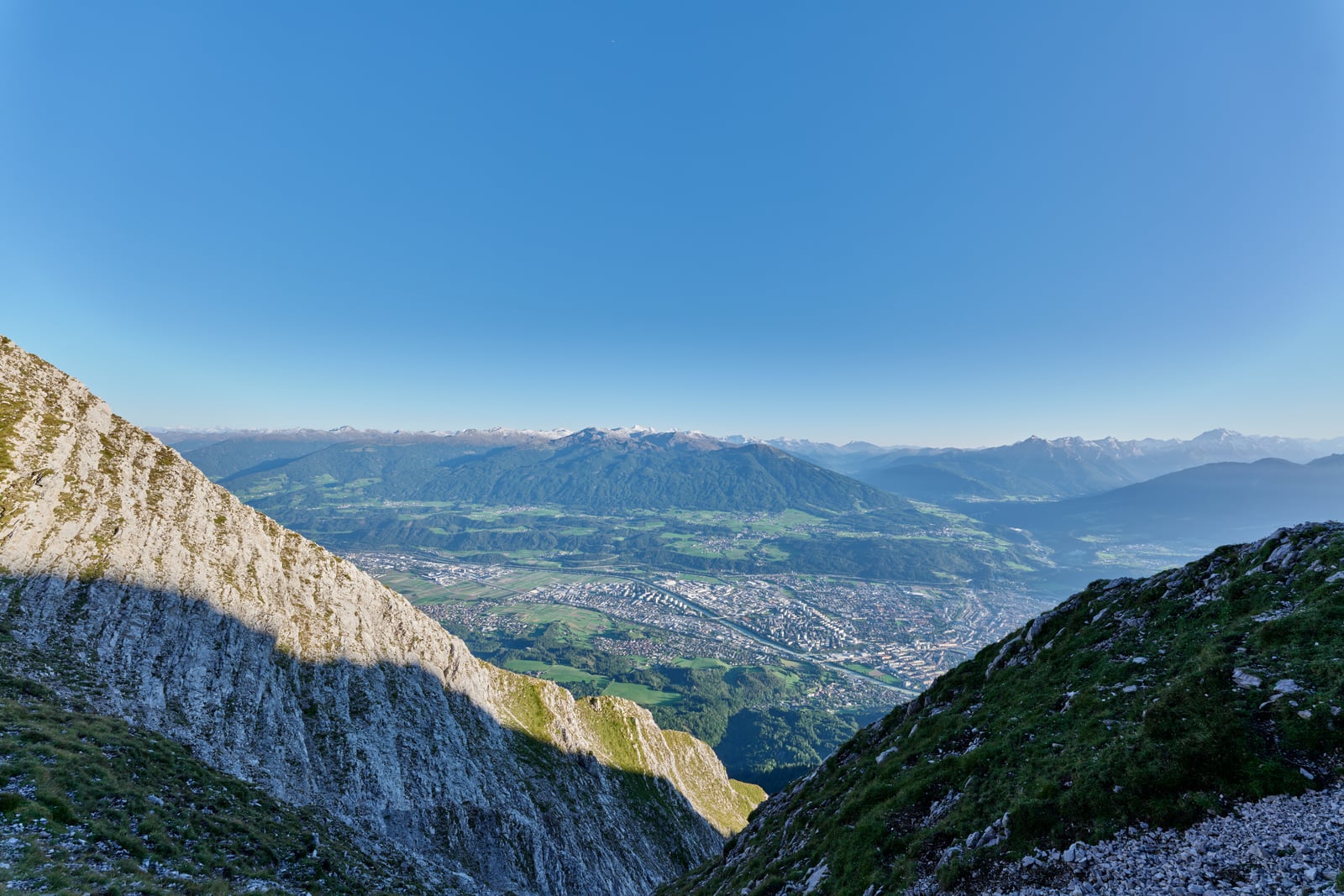
The Seegrube terrace is what people come for: the city directly beneath you, the Inn a pale line through it, the Stubai and Tux Alps filling the far side and the rock of the Nordkette at your back. The drop is severe enough that two people at the rail read as two figures against an entire valley. The terrace faces south, so it is lit all day; the good windows are early morning, before the valley haze builds, and the last two hours, when the ranges opposite turn warm and the city goes into shadow first. On autumn mornings cloud sits in the valley and leaves you above it.
It runs about ten degrees colder than the city and it is usually windy. The railway operates all year, but the timetable is seasonal and there are maintenance closures each spring and autumn — check the day's first and last cars, because missing the last one down means walking. In winter this is a ski area: packed snow, short clean light, the station shared with skiers. Standing positions are on the Nordkette cable car.
What clients say about this kind of shoot
We are overjoyed with the photos from our wedding. Ian and Kiran not only have a fantastic eye for the special moments, they also bring a wonderfully relaxed and caring manner. Our guests were thrilled too! Thank you so much for the priceless memories and for your amazing dedication. We couldn't have wished for a better photographer ♥️
— Behiye O. on Ian P.
We're so happy we chose you! From the very first contact, everything was totally hassle-free and pleasant. Both at the pre-wedding shoot and on the wedding day we felt really comfortable with you, and everything was really relaxed and professional. The photos turned out really great and we're absolutely thrilled with the result! You captured the most beautiful moments of our day perfectly and gave us truly lovely memories. Thank you so much for your amazing work! We'd book you again any time and can't recommend you enough! ❤️
— Chelsea B. on Ian P.
Very professional, likeable and easy to work with. The photos turned out beautifully and capture our wedding day in a very special way. We're very happy and can definitely recommend him!
— Tony P. on Ian P.
Super friendly, creative, dedicated photographers! We clicked right away, they were really accommodating and delivered on time! Absolutely amazing photos that we always love looking at 😍
— Rechusmile on Ian P.
For our wedding, nothing mattered more to us than capturing the special moments and emotions forever. So naturally we had pretty high expectations of our photographers and videographers – and finding them was probably one of the biggest strokes of luck in our wedding. ❤️ On the day itself, we already felt incredibly comfortable with the two of them. They're super friendly, warm-hearted and at the same time absolutely professional. You can tell right away that they know 100% what they're doing, and they still manage to capture the moments completely naturally, without anything feeling posed. At first we even thought we didn't really need a video and were only looking for a photography team. Today we can say: we needed this video!!!🥹 The video truly exceeded our expectations. Watching it feels like living our wedding day all over again – with all the emotions, the voices and the little moments that we ourselves didn't even consciously take in on the day. And the photos turned out simply beautiful too, capturing our day exactly the way we want to remember it. We are incredibly grateful that the two of them were by our side at our wedding and captured these special memories for us. We would choose them again any time and recommend them with all our hearts. ❤️
— Marlene on Ian P.
For our wedding this year, we were looking for someone to capture our special day exactly as we were – authentic, personal, and with all the little moments that made it so special. Since I consider myself a photographer, I had correspondingly high expectations for our wedding photos. Dani not only met them, but absolutely exceeded them. Thank you, Dani, for the incredibly smooth day, the wonderful preliminary discussions, and above all, for being so warm and genuinely interested in us from the very beginning. For everyone reading this: our highest recommendation! Book her, no matter the price; it's definitely worth it – it's the combination of genuine interest in people and photos with an eye for detail. This very mix is what makes her pictures so unique for us. Thank you for capturing our day exactly as we experienced it. We couldn't have wished for anyone better.
— Stefan W. on Dani H.
Bergisel: city, river and mountain in one frame
The Bergisel jump stands on a wooded hill about 250 metres above the city, where the Tyrolean militia fought in 1809. The present tower, finished in 2002 to Zaha Hadid's design, is a single concrete and steel curve with a lift inside and an open terrace at the head of the inrun. From there the jump falls away in one straight line to the outrun and the stadium, and beyond it Innsbruck fills the valley with the whole Nordkette behind — city, mountain and hard modern architecture in a single frame.
The terrace faces roughly north over the city, so it is even and shadowless most of the day; the morning and the last hour are the two windows worth taking, and winter gives the sharpest air of the year. The tower is ticketed, the hours shift with the season and there is a last admission; it also closes around competitions and training days, and the Four Hills round is held here in the first days of January, so check the day before. Tram 1 and the Stubaitalbahn stop at the foot of the hill, ten steep minutes below.
Half an hour by train: Seefeld and the Seekirchl
For an alpine frame with no city in it, the plateau above Innsbruck is easier to reach than the mountain behind it. Trains on the Mittenwaldbahn run to Seefeld in Tirol in roughly half an hour, about hourly — check the current timetable, but it fits inside a morning.
Seefeld sits at about 1,180 metres, and the picture is the Seekirchl: a white chapel with an onion dome, built in 1666, standing alone on open meadow at the western edge of the village with nothing built between it and the mountains. Walk a full circle before you start: from the north the Karwendel closes the view, from the south you get the plateau and the Wetterstein beyond. The facade faces roughly south-west and glows for the last hour of light.
From December the cross-country tracks are groomed right past the chapel and the same frame becomes white ground, blue shadow and the Hohe Munde behind; stay off the classic tracks and work from the trodden edge. Five minutes away the Wildsee is level and mirror-still until the plateau breeze starts mid-morning. More on Seefeld.
What the seasons actually do
Summer gives long evenings — light until nearly nine in June — but haze in the valley by midday, so go up early or late and use the lanes in between; late September and October bring the cleanest air of the warm months. From November the mountain carries snow while the city stays dry, which is Innsbruck's real trick: you photograph in a coat rather than in ski clothing and still have a white range behind you. The sun leaves the valley floor by about four in December, so a winter session is short and early.
Planning an Innsbruck photoshoot
The efficient plan is one low location and one high one inside the same booking. Sixty minutes covers the old town and the river if you start at eight — the Golden Roof, Maria-Theresien-Straße and the Inn are within a ten-minute walk of each other, and none of it needs a ticket. Two hours is the honest minimum as soon as a cable car is involved: the ride up, the walk away from the top station, the shooting and the ride down all have to fit the window, and the timetable rather than the light decides when it ends.
Dress for two climates in one session. What works at the river in a light coat is not enough on the Seegrube, so bring a second layer that looks deliberate on camera — a wool coat, a scarf with some weight — rather than a technical jacket pulled on at the top station.
A photographer who works the city knows which lane is still in shade at nine and whether the cable car is running at all that morning. You can browse Innsbruck photographers and book online, with express sessions from €429 for 60 minutes and €509 for 120, all-inclusive; there is more on the page for Innsbruck and on what a couples session covers.
Want professional photos in Innsbruck?
Browse portfolios, compare packages, and book a verified local photographer in minutes.