Grossglockner High Alpine Road: an alpine photoshoot at 2,500 metres
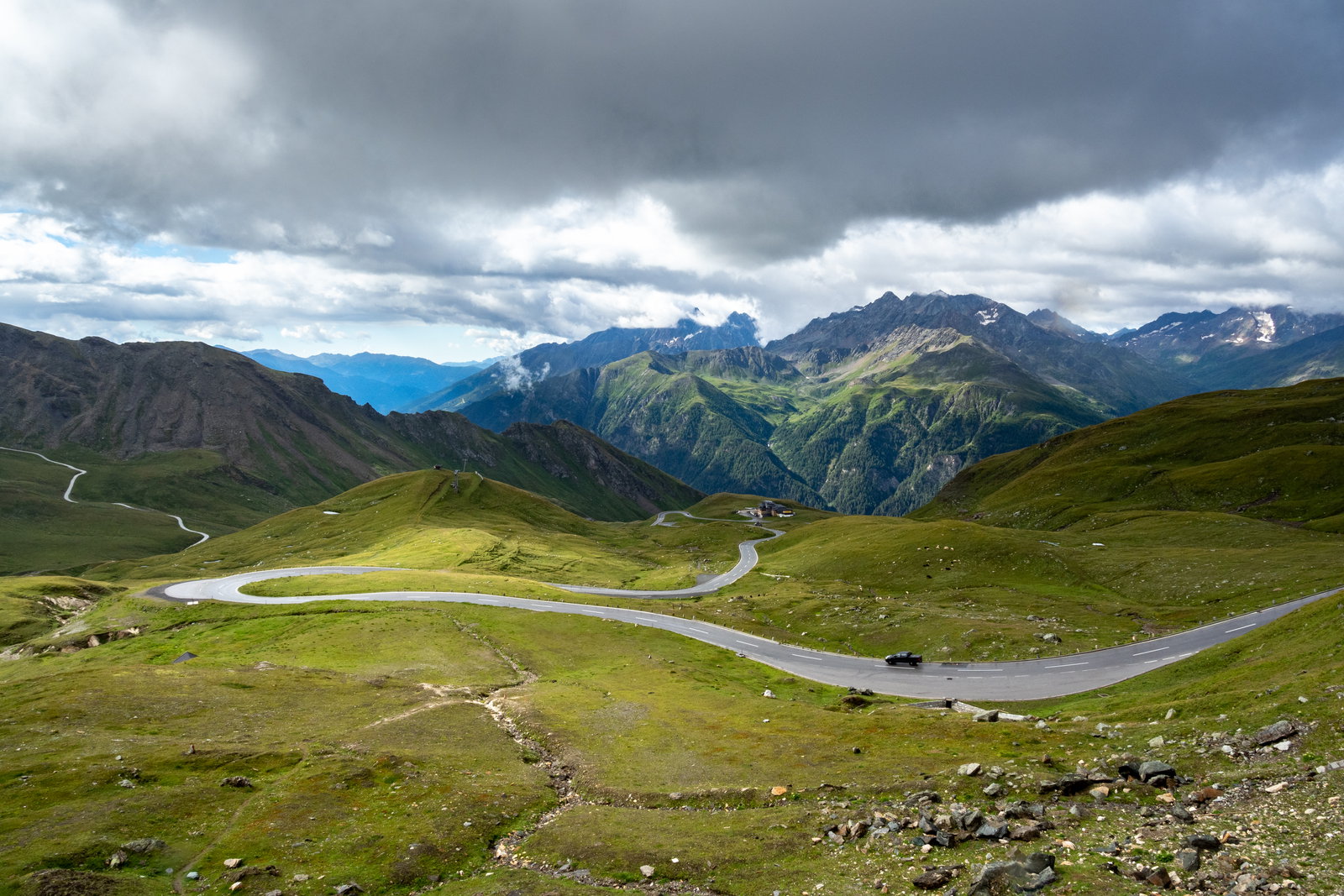
Almost every location in Austria is a question of light. This one is a question of a gate. The Großglockner Hochalpenstraße is 48 kilometres of hairpins from Bruck in Salzburg over the Hochtor at 2,504 metres to Heiligenblut in Carinthia, and it is a toll road with a season and daily opening hours. It generally opens around the start of May and closes with the first serious snow, usually in late October or early November. If the gate is shut, there is no shoot — no alternative approach, no back road, nothing. Plan the day around the barrier first and the light second, and check the current opening, hours and toll before you fix a date, because all three change from year to year.
The road: what you are actually committing to
The road was built in the 1930s as a public works project, purely so that people could drive up and look at mountains, and that intention is visible in every viewing terrace on it. Thirty-six numbered hairpins, a high point at the Hochtor tunnel, toll stations at Ferleiten on the Salzburg side and Heiligenblut on the Carinthian side.
Two practical consequences. First, the gates keep hours: on a summer morning the road opens early, but not before dawn, so the very first light of the day is usually not available to you up here. The first two hours after opening are what you get, and they are the good ones. Second, this is a slow road. Fuscher Törl to the Kaiser-Franz-Josefs-Höhe is well under an hour on paper and longer in practice, because you will stop, because coaches take the bends wide, and because the traffic in front of you is sightseeing too.
The sensible base is Zell am See: about half an hour from Bruck, where the road begins, with a lake and a cable car for the days when the pass is closed. Heiligenblut is the base on the Carinthian side, and the only one that still works in winter.
Kaiser-Franz-Josefs-Höhe and the Pasterze
A spur leaves the pass road on the Carinthian side and ends at a terrace built into the mountainside at 2,369 metres. It looks straight up the Pasterze — the longest glacier in the Eastern Alps, running roughly eight kilometres — to the Großglockner itself at 3,798 metres, the highest mountain in Austria.
For a shoot this is the most forgiving high-alpine location in the country, because the whole picture is available within fifty metres of the car park. The terrace is flat, wide and stepped; nobody has to walk anywhere. That matters more than it sounds when someone is in a dress and the ground is at 2,300 metres.
Be there in the first two hours. You get clear air, side light across the ice and a terrace you can actually work on. By eleven on an August day the car park is full, and cloud usually builds on the summit through the afternoon. The old funicular that used to carry visitors down towards the glacier no longer runs, so reaching the ice now means a long stepped descent and the same climb back — perfectly possible, but an outing rather than part of a session, and worth checking the current state of the path before you count on it. More on the Kaiser-Franz-Josefs-Höhe and the Pasterze glacier.
Fuscher Törl and the Edelweißspitze
The Fuscher Törl is a notch in the ridge at 2,428 metres where the road crosses from one valley system into the other. The viewing area sits on the saddle itself, the ground drops away on both sides, and the road can be seen threading below in both directions. On the rocky knoll above the car park stands a small dark stone chapel, built as a memorial to the workers who died constructing the road. It is set against open sky from almost every angle, and it is the strongest single object anywhere on the pass — the natural place to put two people.
It is also the windiest and coldest stop on the road. It can be near freezing in August when cloud comes over the saddle. That exposure is exactly what makes it photograph well: nothing blocks the light, and weather clearing here is dramatic in a way a sheltered viewpoint never is. But a veil at the Fuscher Törl is a decision, not an accident, and anything light that is not held will go over the edge.
A short branch road, about a kilometre and a half, leaves from here and climbs in tight hairpins to the Edelweißspitze at 2,571 metres — the highest point the road reaches. The final stretch is deliberately cobbled, a 1930s detail nobody has smoothed over. At the top there is a small parking area and a round stone tower on bare rock, with the Hohe Tauern in every direction. There is very little shelter and very little room: this is a summit, not a terrace. Large vehicles are usually not permitted on the spur and it closes earlier in the season than the main road, so check the restrictions.
Heiligenblut: the frame that also works in winter
Heiligenblut sits at the southern foot of the road, in Carinthia, and its Gothic pilgrimage church is the most published image in the region. The church stands on a low rise above the houses, and from the meadow north of the village its slender spire and the Großglockner behind it line up almost exactly, the mountain appearing to stand on the roof.
The alignment holds only from a narrow arc, so walk a hundred metres either way and watch the spire move against the peak until it sits where you want it. Foreground is easy: fences, hay barns, pasture, and in June a meadow full of flowers. The view is roughly north-west, so the peak is backlit in the morning and takes direct light through the afternoon, with the last hour before sunset the best of the day. Cloud on the Großglockner is common and often clears late, which is an argument for patience rather than for an early finish.
This is the one location here that survives the winter. The village stays open and reachable from the Carinthian side all year, even while the pass above it is shut from roughly November to May, and snow on the roofs with the peak behind is the strongest version of the picture. The church interior has its own rules and service times, so check them. More on Heiligenblut church below the peak.
What goes wrong on an elopement up here
The weather is not the main risk; the access is. Build a fallback into the plan before you need one — Heiligenblut from the south, or the lake at Zell am See — so that a closed gate costs you a location and not the day.
Altitude is felt. At 2,400 to 2,500 metres people get cold fast and tire faster, so keep the session short and bring a coat that goes over the outfit between frames. It is often ten degrees colder at the top than in the valley, and snow patches sit on the terraces into July. Shoes matter: these are gravel and cobble surfaces, not lawn. In summer, afternoon thunderstorms build quickly over the Tauern — another reason the morning slot wins.
Finally, nothing on this road is private and nothing can be closed off. It is a working tourist route with coaches, cyclists and motorcyclists on it all day. The only way to an empty frame is to be early. Drone flying and anything production-scale are governed by the road's own rules and by the national park, and those are not the same as elsewhere in Austria, so check before the day rather than on it. An elopement here works precisely because it is small: two people, a photographer, and no logistics that a mountain can break.
Season by season
May and June: snow banks still standing at the top, meadows in flower lower down, long light and few coaches early in the season. July and August: warmest, busiest and the most thunderstorms, so start at the gate. September and October: the clearest air of the year, first snow on the peaks, autumn gate hours shorter and a real chance of an early closure. November to April: the pass is shut and Heiligenblut is the whole location.
Planning a Grossglockner photoshoot
One stop done properly beats three done in a rush. Sixty minutes covers a single terrace and nothing else, which is a perfectly good plan if that terrace is the Kaiser-Franz-Josefs-Höhe. Two hours covers two stops with the drive between them. Three hours buys you a weather window: time to sit out cloud on the Großglockner and still shoot when it clears, which up here is worth more than any extra location.
Express sessions start at €429 for sixty minutes, all-inclusive, and rise to €509 for two hours and €749 for three. Tell us your dates for the Grossglockner High Alpine Road and we will match you with a photographer who drives this pass through the season and knows what the gate is doing, or browse the photographers and book online.
Want professional photos on the Grossglockner High Alpine Road?
Browse portfolios, compare packages, and book a verified local photographer in minutes.