Eloping in Austria: the complete guide (paperwork, locations, photos)
An elopement in Austria is two people, a registrar and a mountain, in that order. The locations are the easy half: the country is full of lakes, baroque squares and glacier terraces that photograph beautifully with a party of two. What catches couples out is the paperwork — not difficult so much as early, because the file has to be open with a registry office months before the date, and only that office can tell you which documents your nationality requires.
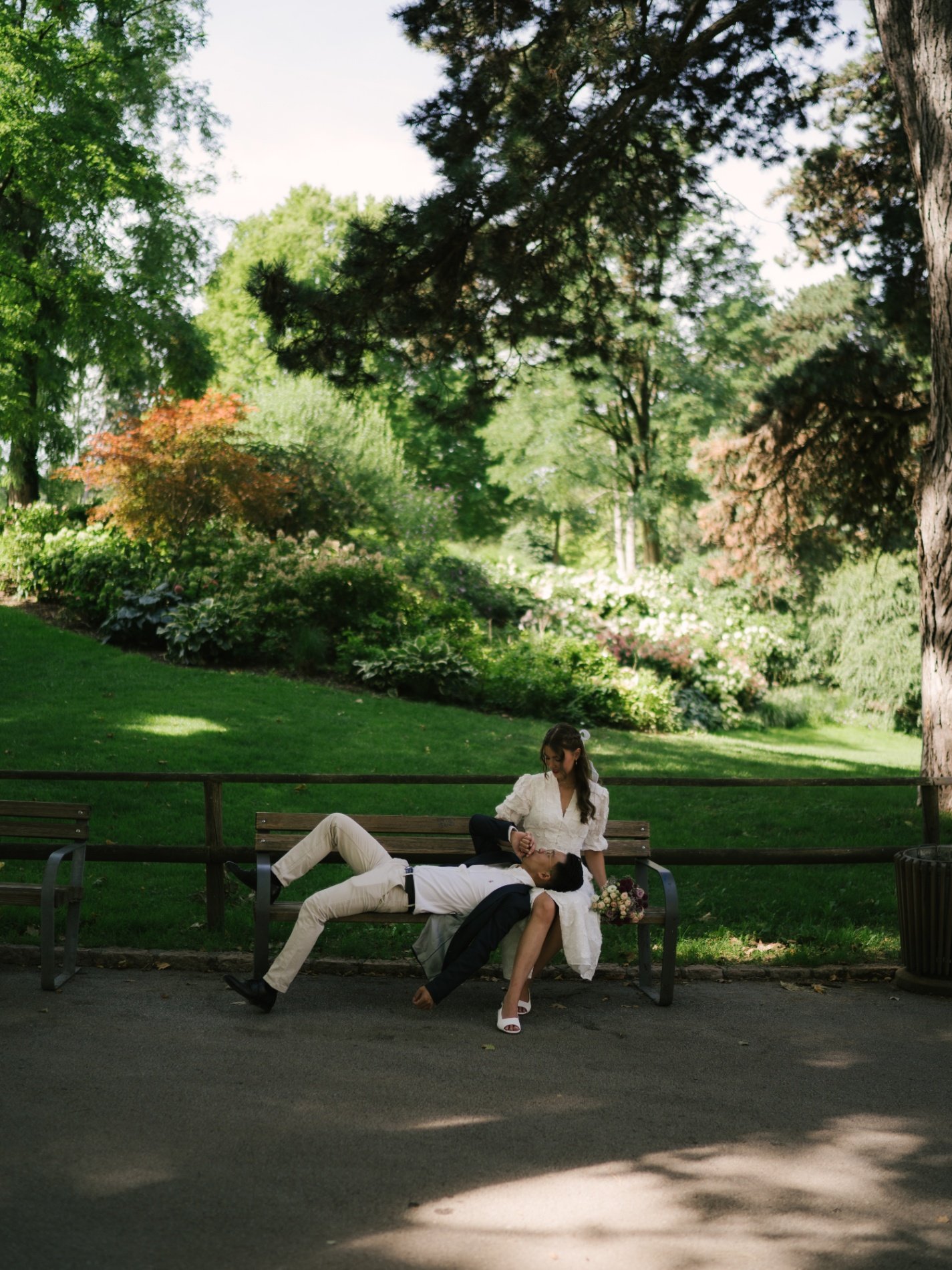
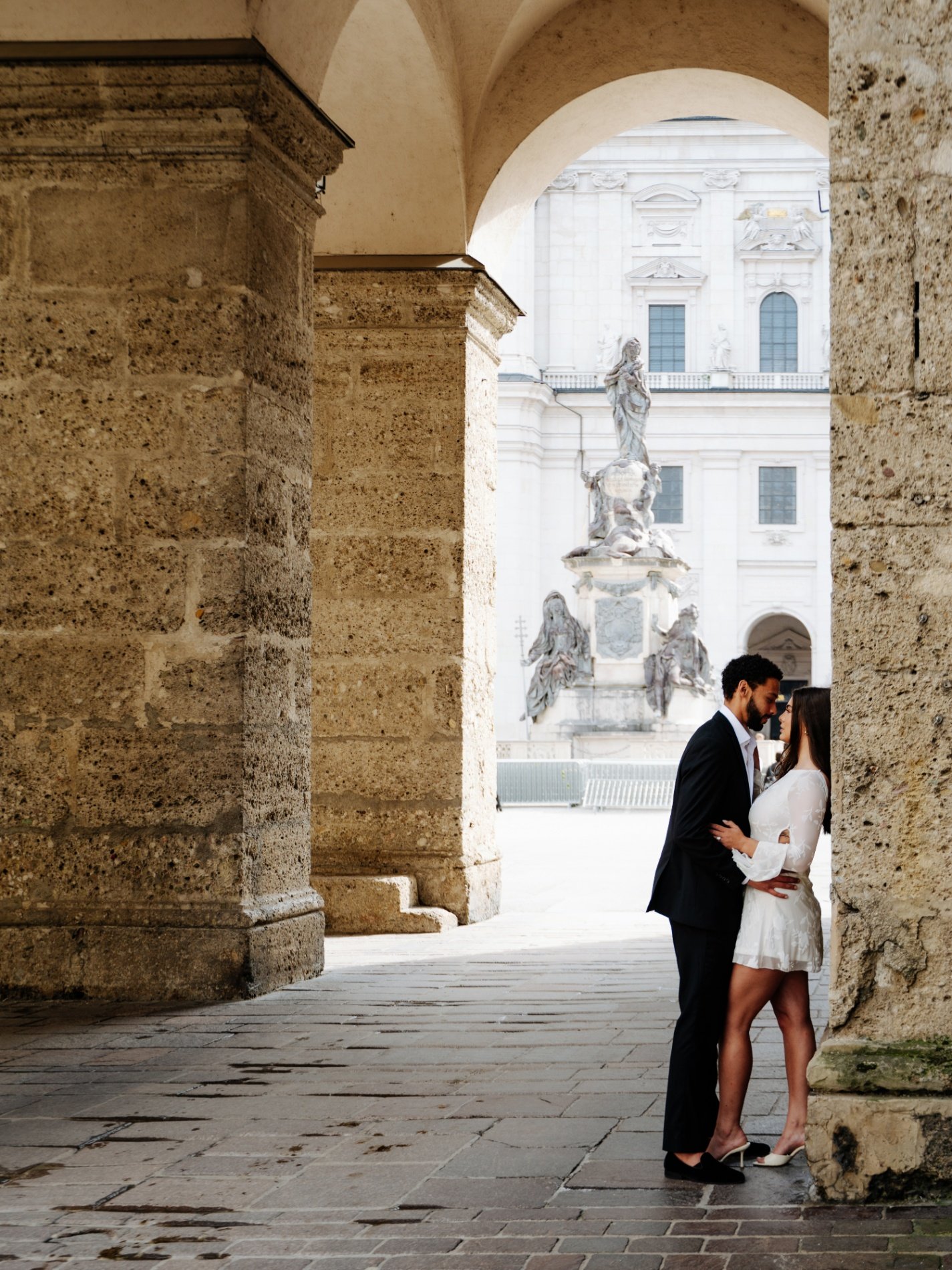
Real shots from Salzburg
Only the civil ceremony counts
In Austria a marriage becomes legally valid through a civil ceremony at a Standesamt. A church wedding or a symbolic ceremony on an alpine meadow can be as meaningful as you like, but on its own it has no civil effect: obligatory civil marriage has been the rule here since 1938. That splits elopements into two workable routes.
The first is to marry legally at home and come to Austria for a symbolic ceremony and the photographs: nothing to file, no translations, no appointment, and you can stand wherever you like — a lake shore at dawn, a hut terrace, a vineyard track.
The second is to marry legally in Austria. There is no residency requirement — people who are neither Austrian nor resident here can marry in Austria — but the office needs a file, and building it takes time. Decide the route before you book flights; it changes the shape of the trip.
The paperwork, and the order it happens in
What follows describes how the process generally runs; it is not legal advice. Requirements depend on your nationality and the only authority on your case is the Standesamt you intend to use — ask them first, in writing.
It starts with registering the intention to marry, a procedure in which the office establishes that you are free to marry. The record it produces is valid for a maximum of six months from the date of determination, which sets both edges of your calendar: a year ahead does not help, three weeks ahead is usually too late.
The documents take the time. Expect photo identification, birth certificates and, if either of you has been married before, evidence of how that marriage ended. Foreign documents generally have to arrive either as an international multilingual form or as a translation by a certified court interpreter, and some also need an apostille or diplomatic legalisation — which of those applies to your country is the question to put to the office before you order anything.
Two practical points that surprise people. If neither of you speaks German you will need a suitable interpreter for both the registration and the ceremony — Vienna states this plainly, and check it wherever you marry. And witnesses are optional: one, two or none, which is what makes eloping here straightforward.
On jurisdiction: the competent office is normally the one covering where one of you lives or is staying in Austria; if neither of you has ever had a residence here, the Vienna Inner City registry office is the fallback, and Vienna's registry service runs a unit for couples with no Austrian residence. There are official fees — the procedure, foreign documents, ceremonies outside office hours — so ask for the current amounts.
Where the ceremony can actually happen
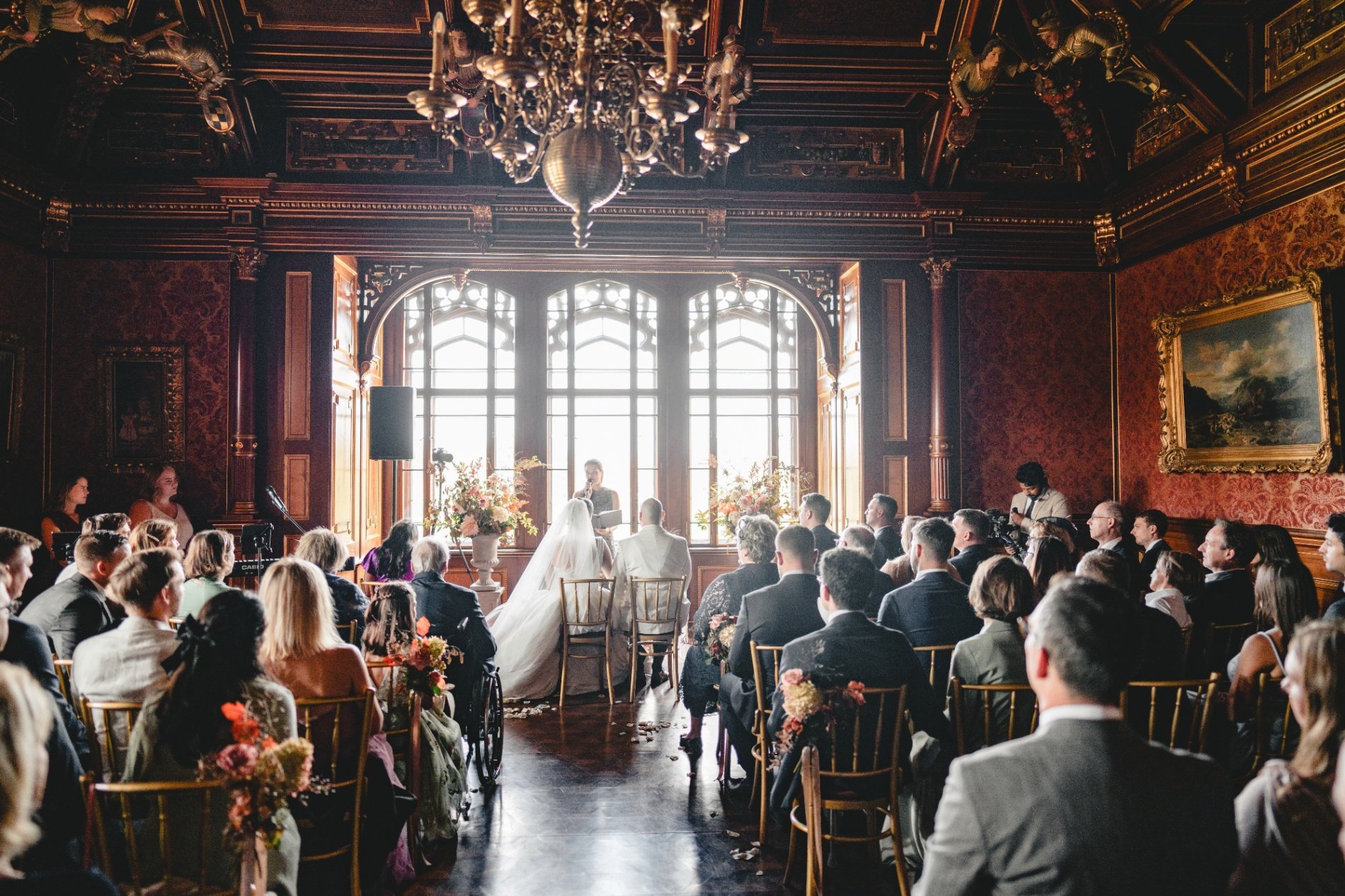
A civil ceremony takes place in the registry office's own rooms, during office hours or outside them for a higher fee. Ceremonies outside official premises are possible, but that is each office's decision, the venue has to be appropriate, and the office only travels within its own area. In practice a registrar may marry you in a castle hall or a lakeside pavilion the office has approved, and will not walk out onto a glacier.
So the shape that works for nearly every elopement here is two-part: a short civil ceremony in a town, and photographs somewhere that has nothing to do with it — a lake at dawn the same day, or a mountain the next morning. Ask the office early which venues it recognises; the answer is local and it changes.
Hallstatt: the elopement everyone pictures
Hallstatt is one street deep and a mountain high, and every frame in it depends on the clock. The view that brought you here — the pointed spire on the water, the pastel houses stacked against the rock, the Dachstein behind — comes from a few metres of railing on the lake road at the north end of the village. At dawn it is yours; by ten the coaches have arrived and it stays busy until about four.
Two other frames carry a session. The wooden boat landing beside the Marktplatz, with the old timber Seehütten on stilts either side, is level, step-free and best at first light or the hour before sunset. Above it, the Welterbeblick skywalk sits roughly 350 metres over the roofs — three minutes up on the salt-mine funicular, which keeps its own season and maintenance closures, so check the dates.
December to March is the quiet reward: snow on the roofs, blue hour at about half past four, far fewer visitors outside the holiday weeks, and a lake that almost never freezes, so the reflection stays. Forty minutes up the valley the Gosausee holds the Dachstein upside down on a calm morning, thirty seconds from the car park. More on Hallstatt.
What clients say about this kind of shoot
We are overjoyed with the photos from our wedding. Ian and Kiran not only have a fantastic eye for the special moments, they also bring a wonderfully relaxed and caring manner. Our guests were thrilled too! Thank you so much for the priceless memories and for your amazing dedication. We couldn't have wished for a better photographer ♥️
— Behiye O. on Ian P.
Very professional, likeable and easy to work with. The photos turned out beautifully and capture our wedding day in a very special way. We're very happy and can definitely recommend him!
— Tony P. on Ian P.
We're so happy we chose you! From the very first contact, everything was totally hassle-free and pleasant. Both at the pre-wedding shoot and on the wedding day we felt really comfortable with you, and everything was really relaxed and professional. The photos turned out really great and we're absolutely thrilled with the result! You captured the most beautiful moments of our day perfectly and gave us truly lovely memories. Thank you so much for your amazing work! We'd book you again any time and can't recommend you enough! ❤️
— Chelsea B. on Ian P.
Super friendly, creative, dedicated photographers! We clicked right away, they were really accommodating and delivered on time! Absolutely amazing photos that we always love looking at 😍
— Rechusmile on Ian P.
Dreamy wedding photos and incredible speed! We couldn't have wished for a better photographer for our special day than Jessica! Even getting to know her in person before the wedding completely convinced us, and we weren't disappointed. She has a wonderful, pleasant manner, so we felt great in front of the camera from the first second. The pictures turned out simply beautiful and capture the emotions of the day perfectly. Another absolute highlight was the speed: we got our finished photos and the highlight video incredibly fast! Dear Jessica, a thousand thanks for these unforgettable memories. We recommend you with all our hearts!
— Bianca B. on Jessica L.
For our wedding, nothing mattered more to us than capturing the special moments and emotions forever. So naturally we had pretty high expectations of our photographers and videographers – and finding them was probably one of the biggest strokes of luck in our wedding. ❤️ On the day itself, we already felt incredibly comfortable with the two of them. They're super friendly, warm-hearted and at the same time absolutely professional. You can tell right away that they know 100% what they're doing, and they still manage to capture the moments completely naturally, without anything feeling posed. At first we even thought we didn't really need a video and were only looking for a photography team. Today we can say: we needed this video!!!🥹 The video truly exceeded our expectations. Watching it feels like living our wedding day all over again – with all the emotions, the voices and the little moments that we ourselves didn't even consciously take in on the day. And the photos turned out simply beautiful too, capturing our day exactly the way we want to remember it. We are incredibly grateful that the two of them were by our side at our wedding and captured these special memories for us. We would choose them again any time and recommend them with all our hearts. ❤️
— Marlene on Ian P.
Salzburg and Vienna: a whole ceremony day on foot
Salzburg is the practical elopement city: compact enough to photograph in one walk and varied enough to fill two hours without repeating a backdrop. Start in the Mirabell gardens, free and open early — around six in summer — where the parterre lines the hedges up on the cathedral domes and the fortress; empty before eight, full of tour groups from ten. Cross the Makartsteg to the Steingasse, a medieval lane in shade all day, then finish on the Mönchsberg, a minute up by the Gstättengasse lift, where the domes, the river and the fortress sit in one frame. Check the calendar: the festival stage occupies Domplatz from late July through August. See Salzburg.
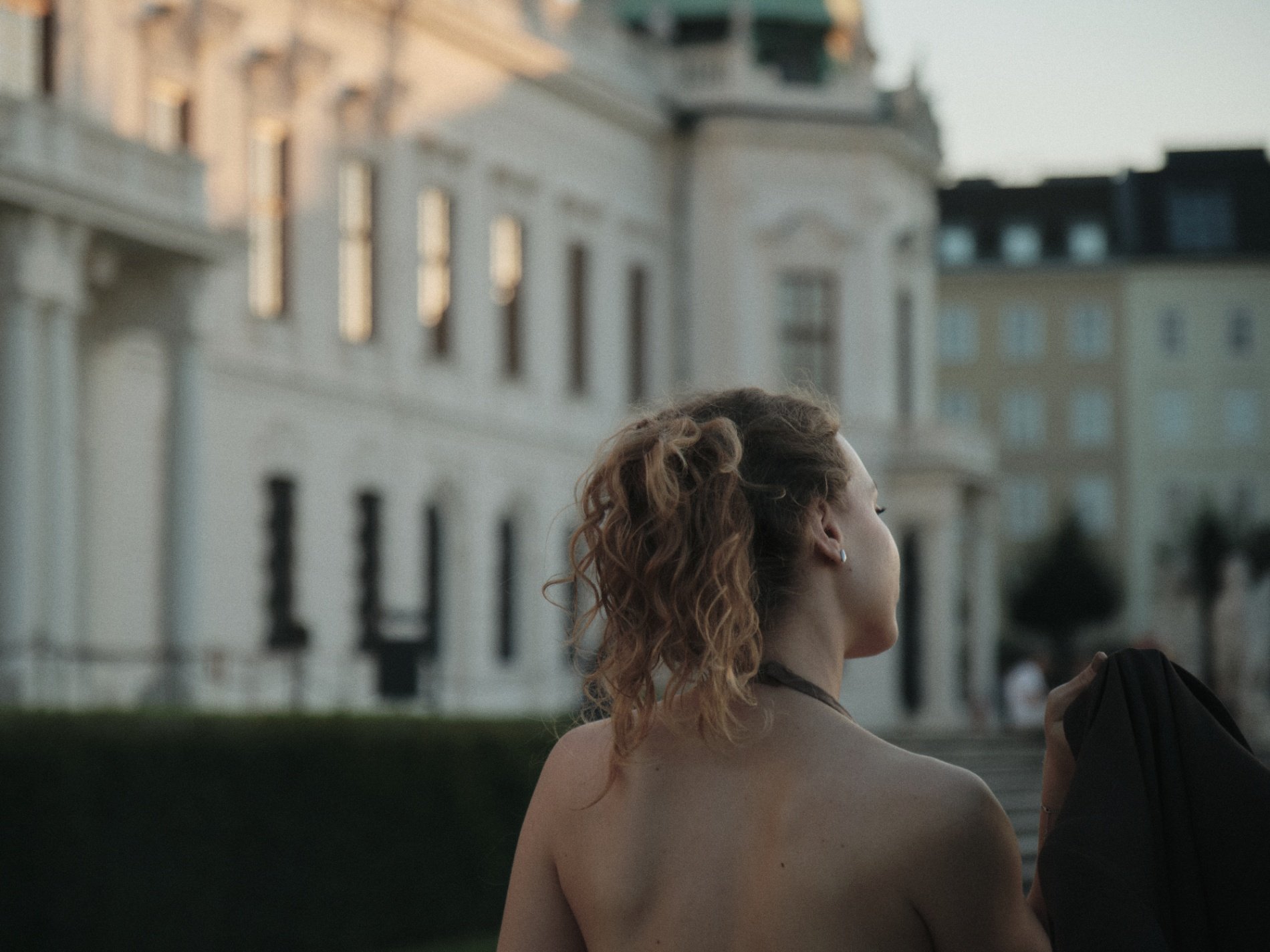
Vienna suits couples who want the paperwork and the pictures in one city. Schönbrunn's park opens at 6:30 and that first hour on the parterre is the whole point; the Belvedere's upper palace doubles in the pool below it on a still morning; Spittelberg's lanes and the coffee houses give interiors when it rains. See Vienna.
The Wachau: a valley with a river in it
If neither a village nor a capital fits, the Wachau is thirty kilometres of Danube between Melk and Krems where every south-facing slope is terraced for vines. Dürnstein is the signature: the powder-blue baroque tower of the abbey church standing on the water, with the castle ruin a steep twenty-five minutes above the main street. Cruise boats fill the village street between about ten and four; before and after it is yours.
Upstream, the dry-stone terraces above Weißenkirchen and Spitz are at their best in the last two hours of light, when the sun rakes along the rows — they are working vineyards, so stay on the tracks. The small cable ferries cross on the current alone, generally spring to autumn, and stop for high water or ice. Season decides everything here: apricot blossom in the first half of April, green June, a gold vintage in October, and a bare, quiet, empty valley from November to March. See the Wachau.
A timeline, and what goes wrong
Six months out, write to the Standesamt: ask for its document list for your nationalities, its dates and whether it marries outside its own rooms. Order certificates and translations the moment that list arrives — apostilles are the step that runs late. Three months out, book the photographer and the accommodation and fix the ceremony slot. In the last fortnight, confirm the interpreter and agree a wet-weather location.
What goes wrong is usually one of four things: a document that needed an apostille nobody mentioned, a marriageability record that expired because the date moved, a cable car closed between seasons, or a plan that tried to fit a ceremony, a lake and a summit into one afternoon. The first two are solved by asking the office early; the last two by one location per session and a spare morning.
Planning an elopement photoshoot in Austria
Two hours is the right length for an elopement, not one. Sixty minutes covers a single location and works when the ceremony is the same morning; 120 minutes lets you do the ceremony and then a second place at the right hour. Sessions are €429 all-inclusive for 60 minutes and €509 for 120.
Book the earliest slot on offer rather than the convenient one: in Hallstatt the hour decides the picture, in Salzburg the gardens empty before eight, and in the Wachau the last two hours of light do all the work. Tell the photographer whether the day includes a ceremony, how you will be dressed and how far you can walk in it.
An elopement photoshoot is booked online in a couple of minutes, and you can browse the photographers who work these lakes, cities and valleys.
Want professional photos in Salzburg?
Browse portfolios, compare packages, and book a verified local photographer in minutes.