Winter Elopement in Austria: snow, chapels and the mountain light
A winter elopement in Austria is a scheduling problem with a very beautiful answer. Snow strips the clutter out of a frame, a chapel standing alone on a white meadow needs no dressing, and two people in dark coats read against all that white from fifty metres away. What ruins it is the clock. Around the solstice the sun is above the horizon in Tyrol for roughly eight and a half hours — up shortly before eight, down soon after half past four — and a deep valley loses direct light long before the official sunset.
Plan the day backwards from four in the afternoon
The usable window is short and it is not where you think it is. In a narrow east-west valley like St. Anton's, the north side, where the village sits, is in shadow by early afternoon in December while the slope opposite still has an hour of sun on it. A high open shelf is different again: Seefeld sits at about 1,180 metres on a broad plateau, above the fog that fills the Inn valley on cold clear days, and keeps clean light most of the day.
So the order that works is ceremony late morning, a warm room in the middle of the day, portraits in the last two hours of light, dinner after dark. If a cable car is in the plan, do the valley first and the mountain second, because that is where the light lasts.
Seefeld: a chapel alone on a white meadow
The Seekirchl — properly the Heilig-Kreuz-Kirche — is the strongest winter frame on this list: a small seventeenth-century church with a dome and a slim tower standing by itself on open meadow at the western edge of Seefeld, with nothing built between it and the Karwendel. You can walk a full circle around it and keep a clean background from every angle. The façade faces roughly south-west, so it takes the last hour of daylight straight on.
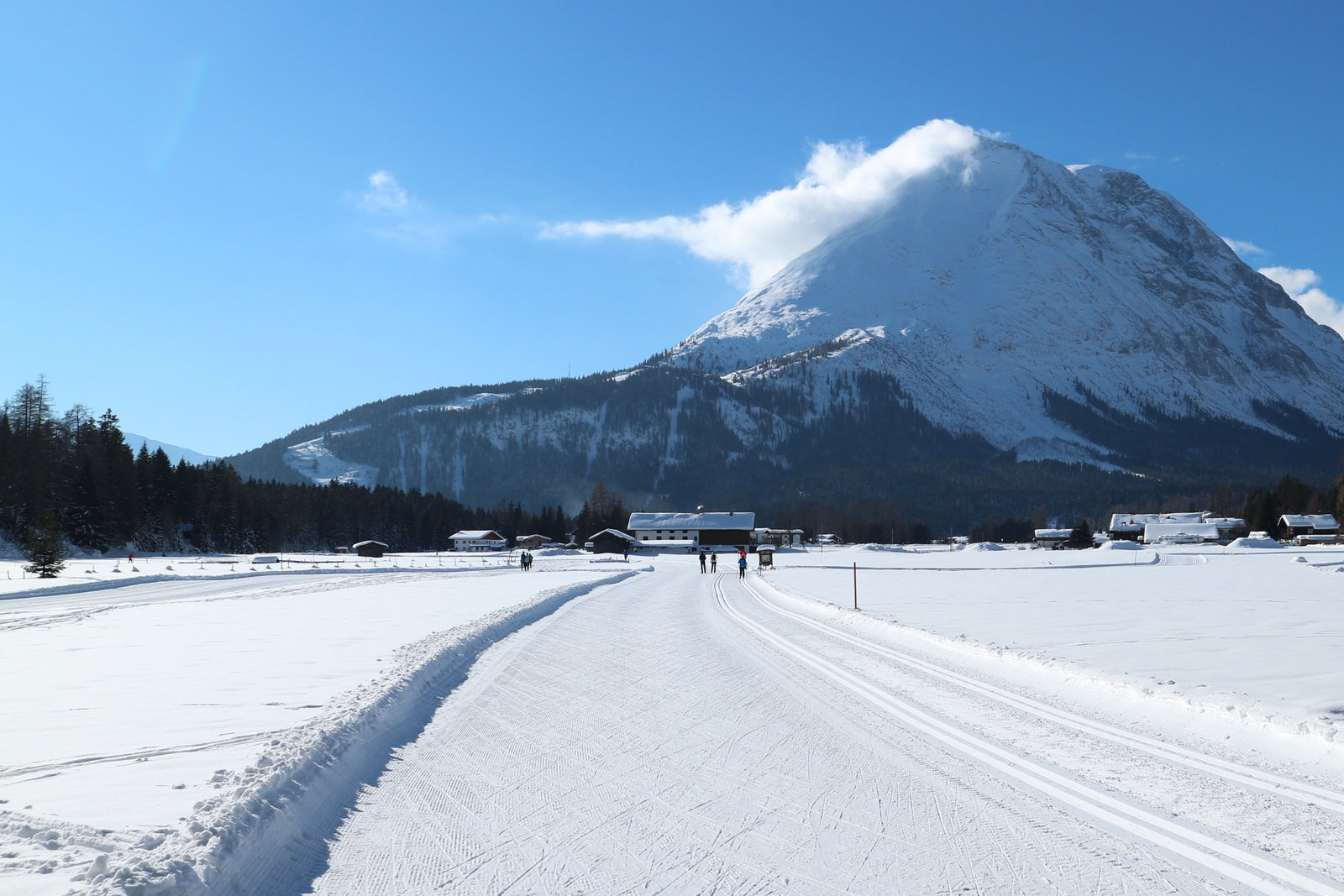
In winter the cross-country tracks are groomed right past the building — stay off the classic tracks, which are in constant use, and work from the trodden edge. The Rosshütte funicular reaches about 1,750 metres from the eastern edge of the village in under ten minutes, but it runs in two seasons with a break between them, so check the operating dates. Both the Seekirchl and the parish church of St. Oswald are used for weddings and the municipality has its own registry office; ask them directly and ask early. Seefeld and the Leutasch is also the easiest of these four to reach — the plateau sits above Innsbruck, not at the end of a long valley road.
Gosau: the Dachstein standing in a frozen lake
The Vorderer Gosausee lies about eight kilometres up the valley from Gosau village at 933 metres, and the frame is a minute from the car park. In summer the draw is the reflection; in winter the lake lies under snow with the grey towers of the Gosaukamm black above it, which is the more graphic version and far emptier. The lake sits in shade until the sun clears the ridge, so light arrives late, low and warm rather than from overhead.
The valley road is ploughed, but conditions change and the upper car park is not always open — check before you commit a ceremony to it. The Gosaukammbahn runs to the Zwieselalm in winter as part of the Dachstein West ski area, with a closed period between seasons and hours that differ year to year. Gosau's registrar will come out to a venue in the valley rather than making you sit in an office — ask the municipality what is currently possible. Gosau and the Gosausee is about twenty minutes from Hallstatt.
The Zillertal: snow you can count on, and a ceremony at a top station
If the date is fixed and the snow is not negotiable, the Zillertal is the answer. The Hintertux glacier, at the head of the Tuxertal about twenty minutes above Mayrhofen, is the only place in Austria that runs every day of the year: lifts to roughly 3,250 metres, snow on the ground in August as in February, and an ice palace inside the glacier with blue-lit chambers that does not care what the weather outside is doing.
Lower down, the Ahornbahn leaves the eastern edge of Mayrhofen with the largest cabins in Austria and reaches the Ahorn plateau at about 1,950 metres in a few minutes. The plateau is open rolling ground with a horizon in every direction, and it faces west, so it keeps light after the valley floor has gone. The hut up there hosts celebrations, and by prior arrangement a civil ceremony at the mountain station is possible; the valley's registry offices sit in Fügen, Zell am Ziller, Mayrhofen and Tux, and they are the people to ask. Lift hours change year to year, so check them. Strike one thing off the winter list: the toll road to the Schlegeis reservoir is closed and unploughed from autumn, so that turquoise belongs to the summer version of the Zillertal.
What clients say about this kind of shoot
We are overjoyed with the photos from our wedding. Ian and Kiran not only have a fantastic eye for the special moments, they also bring a wonderfully relaxed and caring manner. Our guests were thrilled too! Thank you so much for the priceless memories and for your amazing dedication. We couldn't have wished for a better photographer ♥️
— Behiye O. on Ian P.
We're so happy we chose you! From the very first contact, everything was totally hassle-free and pleasant. Both at the pre-wedding shoot and on the wedding day we felt really comfortable with you, and everything was really relaxed and professional. The photos turned out really great and we're absolutely thrilled with the result! You captured the most beautiful moments of our day perfectly and gave us truly lovely memories. Thank you so much for your amazing work! We'd book you again any time and can't recommend you enough! ❤️
— Chelsea B. on Ian P.
Very professional, likeable and easy to work with. The photos turned out beautifully and capture our wedding day in a very special way. We're very happy and can definitely recommend him!
— Tony P. on Ian P.
Super friendly, creative, dedicated photographers! We clicked right away, they were really accommodating and delivered on time! Absolutely amazing photos that we always love looking at 😍
— Rechusmile on Ian P.
For our wedding, nothing mattered more to us than capturing the special moments and emotions forever. So naturally we had pretty high expectations of our photographers and videographers – and finding them was probably one of the biggest strokes of luck in our wedding. ❤️ On the day itself, we already felt incredibly comfortable with the two of them. They're super friendly, warm-hearted and at the same time absolutely professional. You can tell right away that they know 100% what they're doing, and they still manage to capture the moments completely naturally, without anything feeling posed. At first we even thought we didn't really need a video and were only looking for a photography team. Today we can say: we needed this video!!!🥹 The video truly exceeded our expectations. Watching it feels like living our wedding day all over again – with all the emotions, the voices and the little moments that we ourselves didn't even consciously take in on the day. And the photos turned out simply beautiful too, capturing our day exactly the way we want to remember it. We are incredibly grateful that the two of them were by our side at our wedding and captured these special memories for us. We would choose them again any time and recommend them with all our hearts. ❤️
— Marlene on Ian P.
For our wedding this year, we were looking for someone to capture our special day exactly as we were – authentic, personal, and with all the little moments that made it so special. Since I consider myself a photographer, I had correspondingly high expectations for our wedding photos. Dani not only met them, but absolutely exceeded them. Thank you, Dani, for the incredibly smooth day, the wonderful preliminary discussions, and above all, for being so warm and genuinely interested in us from the very beginning. For everyone reading this: our highest recommendation! Book her, no matter the price; it's definitely worth it – it's the combination of genuine interest in people and photos with an eye for detail. This very mix is what makes her pictures so unique for us. Thank you for capturing our day exactly as we experienced it. We couldn't have wished for anyone better.
— Stefan W. on Dani H.
The Arlberg: the snowiest half of the country
From December to April the Arlberg is among the snowiest places in the Alps, and the light on the snow lasts all day. The destination straddles a state border: St. Anton am Arlberg is in Tyrol, Lech and Zürs are in Vorarlberg twenty minutes over the Flexen Pass, and everything except the administration treats them as one place.
Lech is the kinder half for a winter ceremony. It sits in a broad open basin at about 1,450 metres, so the sun reaches the valley floor for most of the day even in Jänner, and the parish church of St. Nikolaus stands with its slim shingled tower right above the young Lech river. From the footbridge downstream you get the tower, black water running between white banks and the peaks behind in one frame. Two warnings: the Flexenstrasse between the two halves closes without notice for avalanche control, sometimes for hours, so check the pass status the same morning; and the small top cabin to the Valluga at 2,811 metres stops in strong wind before the rest of the system does. Treat the summit as a bonus — St. Anton, Lech and the Arlberg has enough at valley level to carry a whole day.
The paperwork starts months before the dress does
Only a civil ceremony at an Austrian Standesamt is legally binding. A church wedding, a blessing on a glacier or a symbolic exchange of vows on a frozen lake does not replace it, and plenty of couples do the legal part at home and the ceremony here — a perfectly normal way to elope. If you want the legal marriage in Austria, expect passports, birth certificates and proof that there is no impediment, usually translated and legalised; which papers apply depends on where you live and which registrar you use. Notice is given in person, and offices only take date reservations inside a window before the day, so write to the specific Standesamt as soon as you have a date.
Warmth, dresses and the extras that work
Boots to the location, shoes in a bag, and a dress that either ends above the snow line or gets carried. A long dark wool coat or a fur-collared cape does far more for the picture than a ski jacket — bring the ski jacket anyway, for the minutes between frames, because fifteen minutes is a long time to stand still at minus ten. Two things to plan around: a camera carried from cold air into a warm hut fogs and stays fogged, so the sequence is outside first and warm room afterwards, not back and forth; and a meadow that looks walkable can be thigh-deep two steps off the trodden line, so the photographer walks it first.
Horse-drawn sleighs are the one winter extra that consistently earns its place, because a sleigh moves at walking pace and gives fifteen minutes of real motion instead of poses. Seefeld has a fiaker rank in the village and the Leutasch runs them too; route, duration and price are agreed with the driver before you set off, and demand peaks over Christmas and the New Year. What does not work is stacking three cable cars into one short day: one village, one meadow, one lift is a full programme when the light goes at half past four.
Planning a winter elopement in Austria
Sixty minutes is enough for one location done properly — the chapel and the meadow around it, or the lake shore and the road above it. Two hours buys a second setting and the walk between them, which in winter is the honest way to get variety without a car chase in the dark. Decide the ceremony time first, then hang the photography on the last two hours of daylight rather than the other way round.
Book earlier than you would in summer: the weeks around Christmas, the New Year and the February half-terms are the busiest in the Alps. Send the photographer your ceremony time, the village and whether you have a car — that decides more than any mood board.
When you are ready, browse photographers who work these valleys and book online, with sessions from €429 all-inclusive, and see what a two-person day usually looks like on our elopement page.
Want professional photos in Seefeld?
Browse portfolios, compare packages, and book a verified local photographer in minutes.