Sunrise or Sunset? Timing a Photoshoot in Austria's Lakes and Mountains
In Austria the sunrise-or-sunset question is not a matter of taste. It is a matter of which way a shore faces and how high the ridge behind it stands. A lake that hands you a flawless mirror at six in the morning can be grey chop at six in the evening, and a summit terrace that looks magnificent in a brochure is backlit and hazy at the hour you were planning to stand on it. The sun is entirely predictable. The mountain in front of it is the variable, and it is the one most people forget to check.
4 photo spots in Achensee — click a pin to open the full guide
Two clocks: the sun's and the ridge's
Start with the sun, because those numbers are fixed. Around the June solstice Vienna gets sunrise at about 04:54 and loses it just before 21:00 — a little over sixteen hours of daylight. Around the December solstice the same city has sunrise at 07:43 and sunset at 16:03, barely eight hours and twenty minutes. In the mountains everything shifts later: the Tyrolean lakes see the sun come up nearer 05:15 in June and go down at about 21:15, and in December sunset there is closer to 16:25. Austria runs on one clock from Vorarlberg to Burgenland, but the sun sets twenty minutes to half an hour later in the west than in Vienna, so a session planned off a Vienna table runs early in Tyrol.
Then subtract the ridge. The published sunrise is the moment the sun clears a flat horizon, which almost nothing here has: in a deep valley the light arrives long afterwards and leaves early. At Hallstatt the village faces east across the water, but the Sarstein on the far shore holds the sun off the houses until mid-morning — which is precisely why the first hour after dawn works there: soft, shadowless, often misty, with no direct light at all. Above Gosau the Vorderer Gosausee sits in shade until the sun clears the rock above it, so the light arrives late, low and warm instead of overhead. Neither is a problem. It becomes one only if you book a sunrise slot expecting sunbeams and get an hour of blue shade.
Dawn on a lake is about air, not light
The reason to get up is rarely the light. It is the air. Overnight the wind drops, the surface goes to glass, mist forms over water still warmer than the sky above it, and the car parks are empty. All three of those things end at roughly the same time.
At the Vorderer Gosausee the reflection is a morning event and nothing else: the valley wind picks up late in the morning, the surface breaks, and from then on you have the Dachstein but not its double. On the Achensee the same thing happens on a bigger scale — the wind gets up around midday and kills the reflections until evening. Treat the first two hours as the session and anything after that as a bonus. Mirror light does not wait for a late breakfast.
Mist is a bonus nobody can book. It forms on cold, clear, still nights over water that has not yet given up its summer heat — in practice late September and October at lake level — and burns off within an hour of the sun reaching the water.
East-facing shores are morning shores
This is the whole trick, and it takes thirty seconds on a map: work out which way the water in front of your backdrop points, and the hour chooses itself.
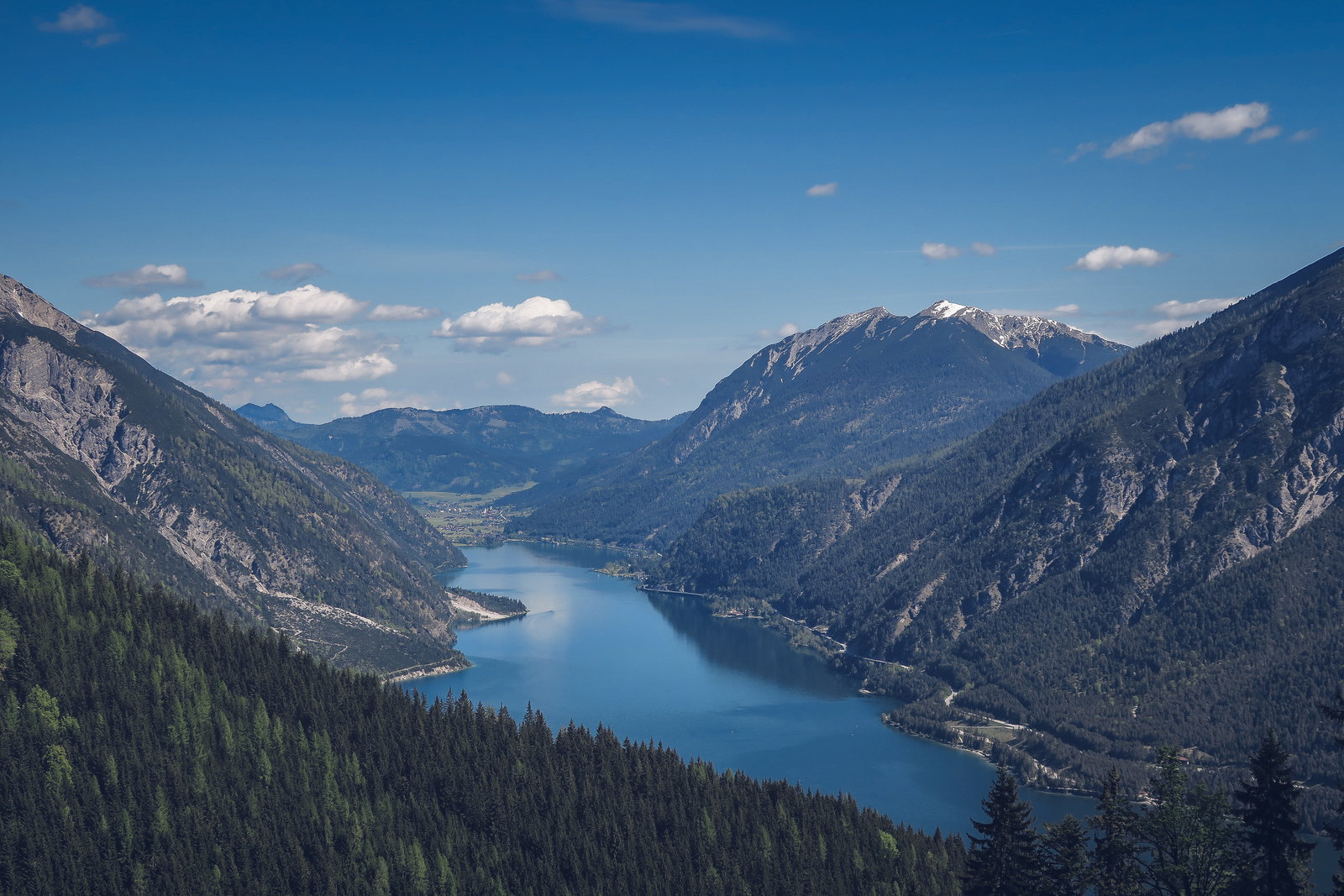
Pertisau, the one flat shore on the Achensee, sits in a bay facing east. In the morning the light comes across the water into the shore and the Karwendel wall opposite is lit while the promenade is still soft; by late afternoon the mountain behind the village throws the whole shore into shadow while the far side stays bright. Velden, at the western end of the Wörthersee, is built facing east down sixteen kilometres of lake, so the morning sun comes straight up the water into the promenade and sunrise is comfortably the strongest hour of its day — by late afternoon the front has gone into flat shade. Zell am See's Esplanade behaves the same way: glass water before nine, and evening light that lands on the far shore at Thumersbach rather than on the town.
If you cannot face a five o'clock alarm in June, move the date rather than the hour: in October sunrise on the same shore is nearly three hours later.
West and south-west places belong to the evening
The mirror image is just as reliable. Maria Wörth's two churches on their headland take their light from the south-west, so the last two hours of the day are the strong ones: the shingled spire warms and the water behind it goes dark. Above Gosau, the Zwieselalm looks west across the valley at the Gosaukamm, so the ridge takes direct light through the afternoon and the last hour before sunset is the best of the day. Go up in the morning and you get the towers in silhouette — a good picture, but not the one most people have in mind. The Gosaukamm's own rock faces east, takes the sun early, then turns pale gold for the last half hour of daylight while the valley beneath is already dark.
What clients say about this kind of shoot
We are overjoyed with the photos from our wedding. Ian and Kiran not only have a fantastic eye for the special moments, they also bring a wonderfully relaxed and caring manner. Our guests were thrilled too! Thank you so much for the priceless memories and for your amazing dedication. We couldn't have wished for a better photographer ♥️
— Behiye O. on Ian P.
We're so happy we chose you! From the very first contact, everything was totally hassle-free and pleasant. Both at the pre-wedding shoot and on the wedding day we felt really comfortable with you, and everything was really relaxed and professional. The photos turned out really great and we're absolutely thrilled with the result! You captured the most beautiful moments of our day perfectly and gave us truly lovely memories. Thank you so much for your amazing work! We'd book you again any time and can't recommend you enough! ❤️
— Chelsea B. on Ian P.
Very professional, likeable and easy to work with. The photos turned out beautifully and capture our wedding day in a very special way. We're very happy and can definitely recommend him!
— Tony P. on Ian P.
Super friendly, creative, dedicated photographers! We clicked right away, they were really accommodating and delivered on time! Absolutely amazing photos that we always love looking at 😍
— Rechusmile on Ian P.
For our wedding, nothing mattered more to us than capturing the special moments and emotions forever. So naturally we had pretty high expectations of our photographers and videographers – and finding them was probably one of the biggest strokes of luck in our wedding. ❤️ On the day itself, we already felt incredibly comfortable with the two of them. They're super friendly, warm-hearted and at the same time absolutely professional. You can tell right away that they know 100% what they're doing, and they still manage to capture the moments completely naturally, without anything feeling posed. At first we even thought we didn't really need a video and were only looking for a photography team. Today we can say: we needed this video!!!🥹 The video truly exceeded our expectations. Watching it feels like living our wedding day all over again – with all the emotions, the voices and the little moments that we ourselves didn't even consciously take in on the day. And the photos turned out simply beautiful too, capturing our day exactly the way we want to remember it. We are incredibly grateful that the two of them were by our side at our wedding and captured these special memories for us. We would choose them again any time and recommend them with all our hearts. ❤️
— Marlene on Ian P.
For our wedding this year, we were looking for someone to capture our special day exactly as we were – authentic, personal, and with all the little moments that made it so special. Since I consider myself a photographer, I had correspondingly high expectations for our wedding photos. Dani not only met them, but absolutely exceeded them. Thank you, Dani, for the incredibly smooth day, the wonderful preliminary discussions, and above all, for being so warm and genuinely interested in us from the very beginning. For everyone reading this: our highest recommendation! Book her, no matter the price; it's definitely worth it – it's the combination of genuine interest in people and photos with an eye for detail. This very mix is what makes her pictures so unique for us. Thank you for capturing our day exactly as we experienced it. We couldn't have wished for anyone better.
— Stefan W. on Dani H.
On a mountain, the lift decides, not the sun
This is where alpine plans fall over. Most Austrian cable cars stop running well before sunset for much of the year, so a summit sunset is often not on offer at all: you will be on the last descent while the light is still building. Check the last ride down first, and if the day depends on being high up, check the operating dates too — nearly every lift closes for weeks between the summer and winter seasons, and the hours move year to year.
Where the numbers do work, aim early. The Erfurter Hütte above the Achensee, eight minutes up from Maurach on the Rofan cable car, looks north and west over all nine kilometres of the lake: the Karwendel wall is lit through the morning, the air is at its clearest, and late afternoon up there is strongly backlit. The Pyramidenkogel tower above the Wörthersee is the opposite case: the lake lies north of it, so the water is at its strongest colour in the middle of the day and the mountains behind are best in the first and last hours.
Blue hour, and why winter makes it easy
After the sun has gone there is a second window worth planning for. The useful blue light runs about half an hour around the equinoxes and roughly thirty-five to forty minutes in midwinter and midsummer. What changes wildly is when it falls.
In December it lands between about 16:05 and 16:45 in the east and half an hour later in the west: lit windows, snow going blue, everybody still awake. Hallstatt's blue hour arrives at half past four, with the village at its emptiest of the year. In late June the same light does not finish until nearly ten at night in Tyrol — a long evening with children, and a very short night before a half past four start.
Season moves the answer more than the hour does
June gives you sixteen hours and the worst air of the year: haze over the valleys, cloud stacking on the high ranges from late morning, so a summit is a morning job in summer whatever the forecast says. October is the photographer's month — larch gold, mist at dawn, the clearest air, far fewer people at the famous viewpoints and a civilised sunrise. Winter is short but generous: the sun never gets high, so the light rakes all day.
Planning a sunrise or sunset photoshoot in Austria
Sixty minutes is the right length for one shore or one summit at the right hour. A hundred and twenty gives you a lake at dawn and the walk that follows it, or a village and the viewpoint above it, without either half feeling rushed. Fitting a sunrise lake and a sunset mountain into one session is the classic mistake: those are two bookings on two mornings.
Book earlier in the season than feels necessary: the dawn slots at the Achensee, the Gosausee and the Wörthersee go first. Tell the photographer what you want in the frame — the mirror, the ridge, the empty village — because the answer changes the meeting time by hours, not minutes.
A local photographer already knows which shore is lit at seven and which is in shadow at five, and will say so before you drive an hour in the wrong direction. You can browse photographers across Austria and book online, with couples sessions from €429 all-inclusive.
Want professional photos on the Achensee?
Browse portfolios, compare packages, and book a verified local photographer in minutes.