
Proposing in Hallstatt: the viewpoint, the boat and the timing
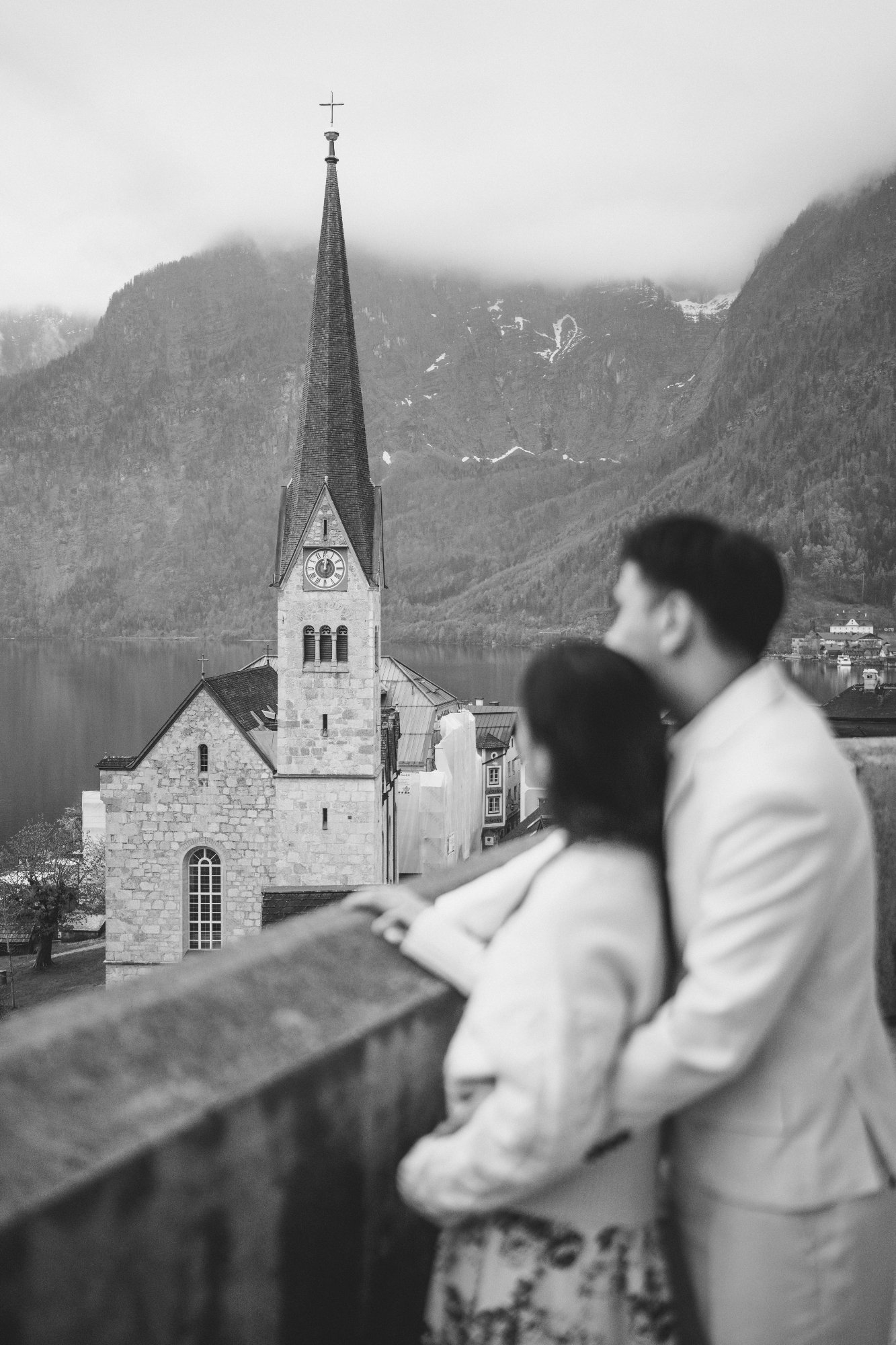
A proposal in Hallstatt lives or dies on the clock. The picture in your head — the pointed spire standing on the water, the pastel houses stacked up the rock, the Dachstein closing the valley behind them — is taken from about four metres of railing on a public lake road, and from ten in the morning until four in the afternoon those four metres hold a slow-moving queue of phones. At dawn the same railing is empty and the light is better. Every other decision here — viewpoint or boat, funicular or village square, where the photographer stands — follows from that one.
The classic viewpoint, and why it has to be dawn
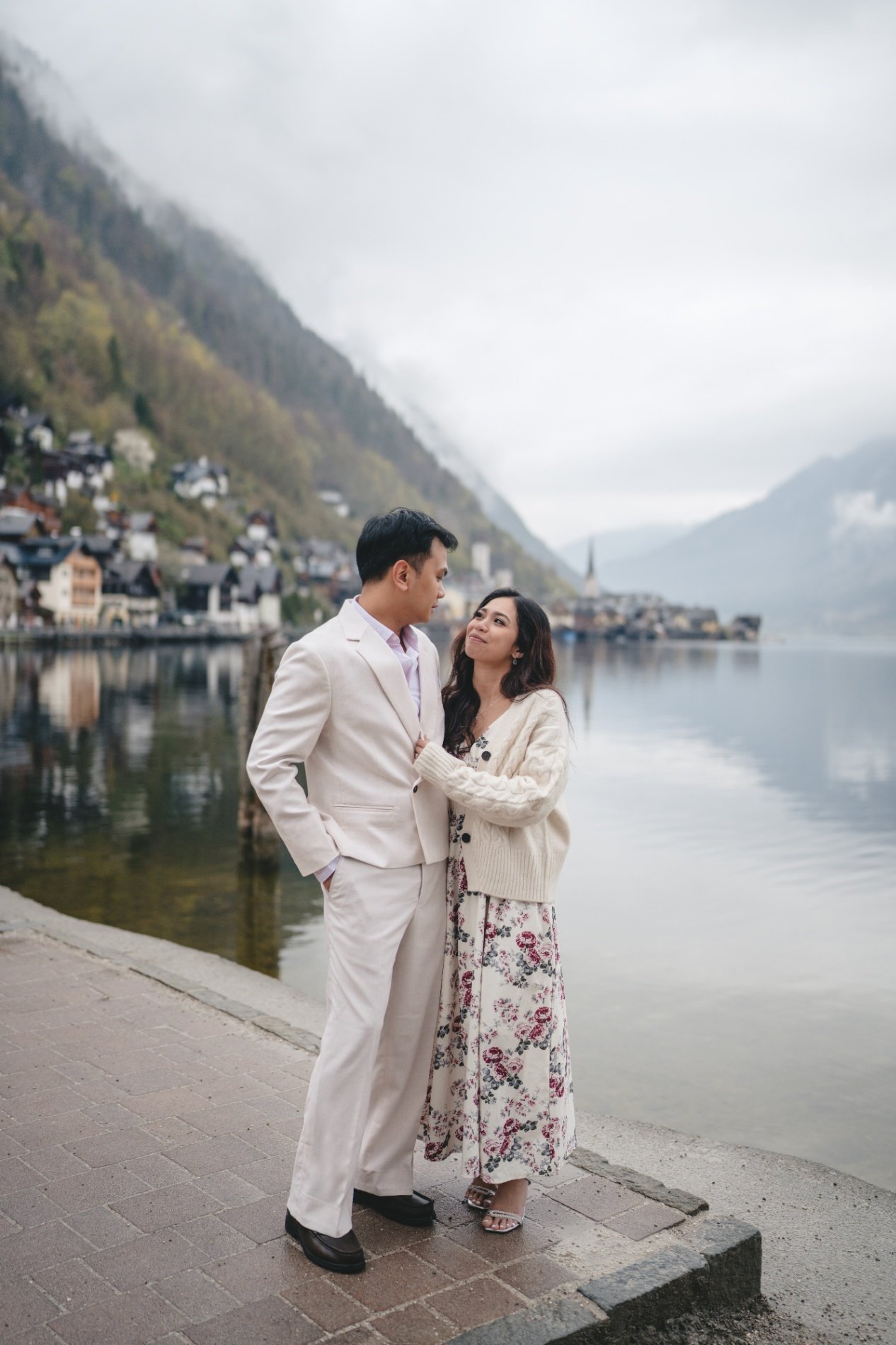
Gosaumühlstraße is the lake road running north out of the village. About four hundred metres past the last houses the pavement widens and the whole postcard arrives at once: Hallstatt pressed between the water and the wooded Salzberg, the spire of the Protestant church standing on the shore, the Dachstein massif shutting the far end of the lake. Three or four metres of railing carry the frame. Step ten metres either way and a tree takes the spire.
The village faces east across the water, and the Sarstein ridge on the opposite shore holds the sun back until mid-morning. That is the whole reason dawn works here: no direct light at all, no shadows to fight, mist off the lake more often than not, and the colour of the render doing the work instead of the sun. By nine the house fronts take the light. By ten the coaches from the car parks above the village have arrived, and the railing stays three deep until late afternoon.
It is a fifteen-minute walk from the Marktplatz, level the whole way, so there is no reason to drive up. It is also a narrow public road with buses and delivery vans on it and no pavement along part of the stretch — stay inside the railing, keep the two of you together, and do not spread the moment across the carriageway. In winter it is icy underfoot more often than it looks. There is more on exactly where to stand at the classic viewpoint on Gosaumühlstraße.
On the water, where nobody can walk into the frame
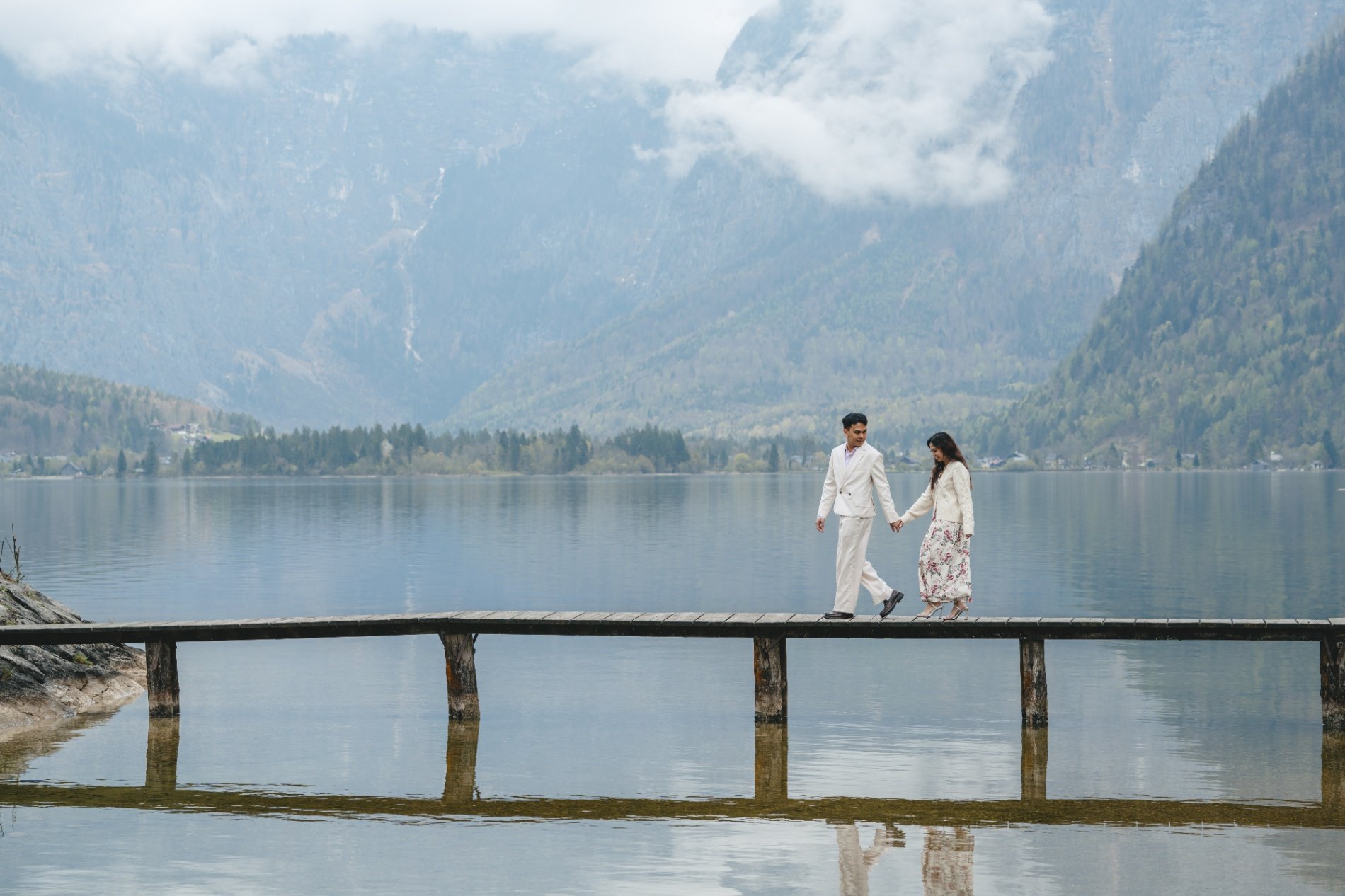
Hallstatt has no road bridge and never had one. The trains stop on the far shore and a small boat has met them since the nineteenth century, crossing in about ten minutes and tying up at the wooden landing beside the Marktplatz. On either side of it the old Seehütten stand on stilts over the shallows — timber boathouses with double doors opening straight onto the water, dark wood against pale render.
Boat hire operates from the village centre and from Lahn at the southern end, and small electric boats can generally be taken out without a licence. The season runs roughly from April to October and depends on the weather, so check what is actually running the week you arrive. Twenty minutes out on the lake gives you the frontal view of the village that the postcards use and, more usefully, a frame that no stranger can wander into.
Two honest warnings. You cannot kneel in a small electric boat without both of you getting wet, so if the kneeling matters, do that on the pier and take the boat afterwards. And a ring box is the wrong object to be handling over open water: keep it in a zipped inside pocket until the boat is tied up again.
The Skywalk when the lake is grey
Above the village the Welterbeblick platform juts out of the Salzberg beside the Rudolfsturm, roughly 350 metres over the roofs, and it gives you the opposite light to the lake road. It faces north-east across the village, so the morning is clean, the middle of the day is workable, and by late afternoon the valley below is already in shadow while the far ridges still burn. Most people arrive on the salt-mine funicular from Lahn, which takes three minutes; the walking alternative is properly steep and runs forty-five minutes to an hour.
The funicular keeps a season with its own opening dates and a last ascent, and it closes for maintenance periods — check the current dates before building a proposal around the ride, because being turned back at the bottom station is a poor start to a morning. It is exposed up there and a few degrees colder than the village, with wind: bring the layer you would not need below. See the Welterbeblick skywalk above the village.
The hours that are yours, and the hours that are not
Dawn to nine belongs to you. Nine to ten fills. From ten until about four the viewpoint is unusable for anything private, and the sensible place to be is the Marktplatz — a cobbled square of narrow pastel houses around the Trinity column, in shade for most of the day because the Salzberg rises straight behind it. It is the one frame in the village that survives flat midday light, and the alleys running off it give the same houses without the crowd. The café tables are not public ground, so ask before working around them.
After four the day-trippers leave for Salzburg and the light comes back. In winter the arithmetic changes completely: far fewer coaches outside the holiday weeks, snow on the roofs, blue hour arriving around half past four in December, and a lake that almost never freezes, so the reflection stays. Advent weekends are the exception, and they are busy.
What clients say about this kind of shoot
We are overjoyed with the photos from our wedding. Ian and Kiran not only have a fantastic eye for the special moments, they also bring a wonderfully relaxed and caring manner. Our guests were thrilled too! Thank you so much for the priceless memories and for your amazing dedication. We couldn't have wished for a better photographer ♥️
— Behiye O. on Ian P.
We're so happy we chose you! From the very first contact, everything was totally hassle-free and pleasant. Both at the pre-wedding shoot and on the wedding day we felt really comfortable with you, and everything was really relaxed and professional. The photos turned out really great and we're absolutely thrilled with the result! You captured the most beautiful moments of our day perfectly and gave us truly lovely memories. Thank you so much for your amazing work! We'd book you again any time and can't recommend you enough! ❤️
— Chelsea B. on Ian P.
Very professional, likeable and easy to work with. The photos turned out beautifully and capture our wedding day in a very special way. We're very happy and can definitely recommend him!
— Tony P. on Ian P.
Super friendly, creative, dedicated photographers! We clicked right away, they were really accommodating and delivered on time! Absolutely amazing photos that we always love looking at 😍
— Rechusmile on Ian P.
Dreamy wedding photos and incredible speed! We couldn't have wished for a better photographer for our special day than Jessica! Even getting to know her in person before the wedding completely convinced us, and we weren't disappointed. She has a wonderful, pleasant manner, so we felt great in front of the camera from the first second. The pictures turned out simply beautiful and capture the emotions of the day perfectly. Another absolute highlight was the speed: we got our finished photos and the highlight video incredibly fast! Dear Jessica, a thousand thanks for these unforgettable memories. We recommend you with all our hearts!
— Bianca B. on Jessica L.
For our wedding, nothing mattered more to us than capturing the special moments and emotions forever. So naturally we had pretty high expectations of our photographers and videographers – and finding them was probably one of the biggest strokes of luck in our wedding. ❤️ On the day itself, we already felt incredibly comfortable with the two of them. They're super friendly, warm-hearted and at the same time absolutely professional. You can tell right away that they know 100% what they're doing, and they still manage to capture the moments completely naturally, without anything feeling posed. At first we even thought we didn't really need a video and were only looking for a photography team. Today we can say: we needed this video!!!🥹 The video truly exceeded our expectations. Watching it feels like living our wedding day all over again – with all the emotions, the voices and the little moments that we ourselves didn't even consciously take in on the day. And the photos turned out simply beautiful too, capturing our day exactly the way we want to remember it. We are incredibly grateful that the two of them were by our side at our wedding and captured these special memories for us. We would choose them again any time and recommend them with all our hearts. ❤️
— Marlene on Ian P.
The ring, the cold and the small mechanics
Cold is the practical enemy of a Hallstatt proposal for two thirds of the year. Fingers stop cooperating at four degrees, rings do not slide onto cold hands, and stone that looks dry at dawn is usually damp. Small things that save the moment: carry the ring in a coat pocket you can actually reach, not a trouser pocket that is unreachable once you are kneeling; a soft pouch does not print through a jacket the way a hinged box does; and hand the ring to nobody, at any point, including the photographer.
Then plan for what comes after. The twenty minutes following a yes are the best material of the day and the part couples forget to allow for — the phone calls, the laughing, the shaking hands, sitting down on the steps because your legs have gone. Let that run and let it be photographed instead of moving straight into posing.
How the photographer stays invisible
The classic viewpoint is a long straight railing, which is the easiest geometry in Austria to hide in. A photographer sixty or eighty metres along it with a long lens looks exactly like everyone else photographing the village, and in summer there are a great many of them. On the pier and on the Marktplatz the trick is the same: stand where a visitor would stand, shoot what a visitor would shoot.
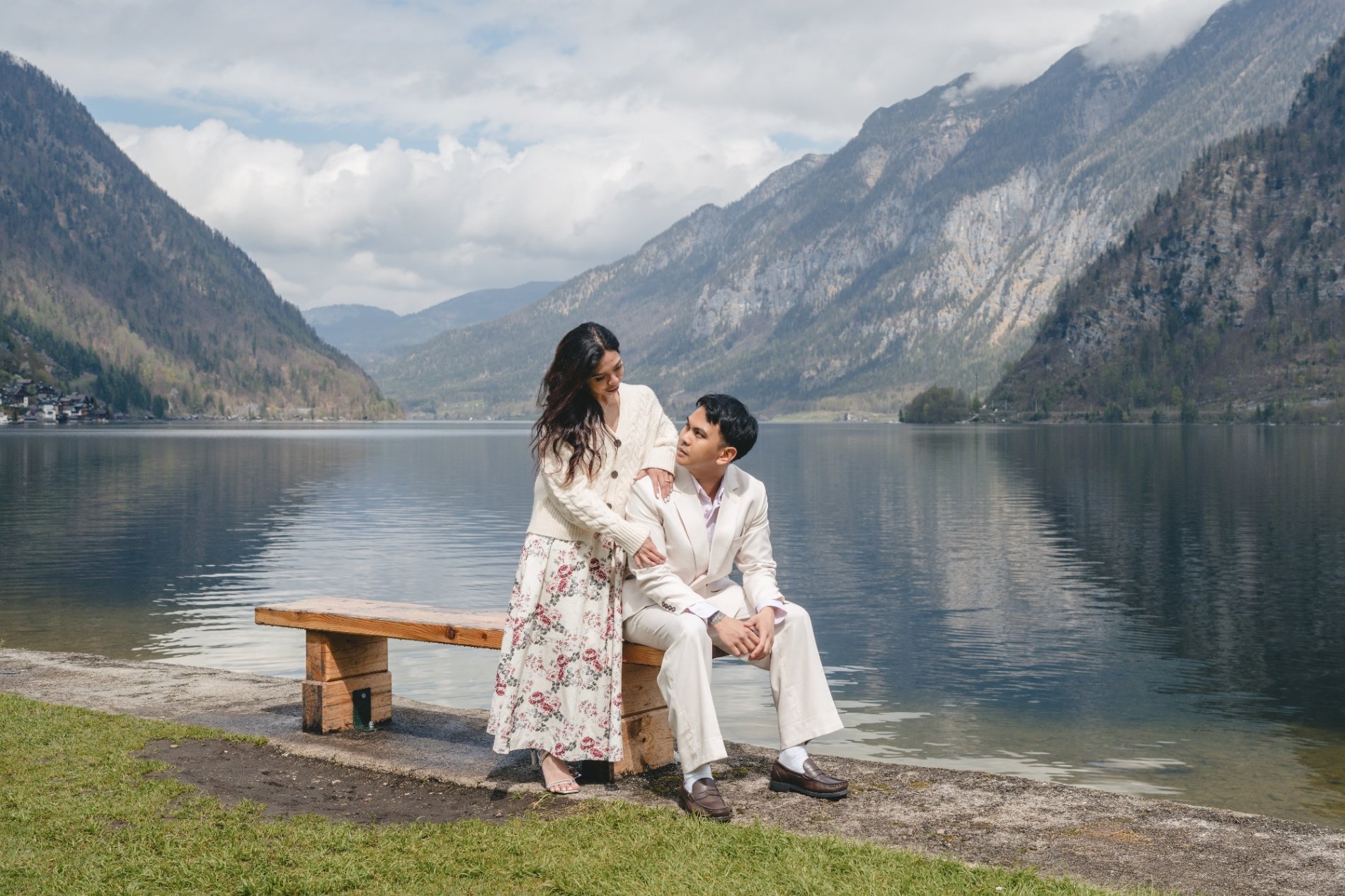
The rest is choreography agreed in advance. A visible signal that costs nothing — a hat coming off, a hand into a pocket, stopping at an agreed bench. A meeting point twenty minutes earlier, somewhere the other person has no reason to walk past. And no words that give it away; nobody says the word photographer out loud in a village this small. After the yes, the photographer walks in, introduces themselves and the session turns into a normal couples shoot, which is when everyone relaxes and the pictures get better.
When the weather has other plans
The Salzkammergut is one of the wetter corners of Austria, and a grey morning is not a lost morning: the pier, the boathouses and the Marktplatz all work under cloud, and a low ceiling on the Dachstein is more atmospheric than a blue sky. Wind is the real problem, because it takes the reflection off the lake — that is the morning to go up rather than along.
If the whole day is written off, the Gosausee is about forty minutes up the valley by car, and on a calm morning it holds the Dachstein, its glacier and the grey towers of the Gosaukamm upside down in the water, thirty seconds from the car park. It is the strongest second option in the region: Gosau and the Gosausee.
Planning a proposal in Hallstatt
Sixty minutes is enough. A proposal session is a short, tightly planned thing: a fixed meeting point, one location, the surprise in the first ten minutes and a relaxed couples shoot afterwards. Book the earliest slot the photographer offers rather than the convenient one — in this village the hour decides the picture.
Give the photographer the practical details in advance: which direction you will walk in, what you will be wearing, the signal, and whether anyone else is in on it. If you are travelling in winter, agree the fallback location at the same time, because a wind that arrives overnight changes the plan and nobody wants to be making that decision at seven in the morning.
Sessions in Hallstatt start at €429 all-inclusive for sixty minutes. If you want the surprise handled end to end, a proposal photoshoot is booked online in a couple of minutes, and you can browse the photographers who work this lake every week.
Want professional photos in Hallstatt?
Browse portfolios, compare packages, and book a verified local photographer in minutes.